


- admin
- November 18, 2022
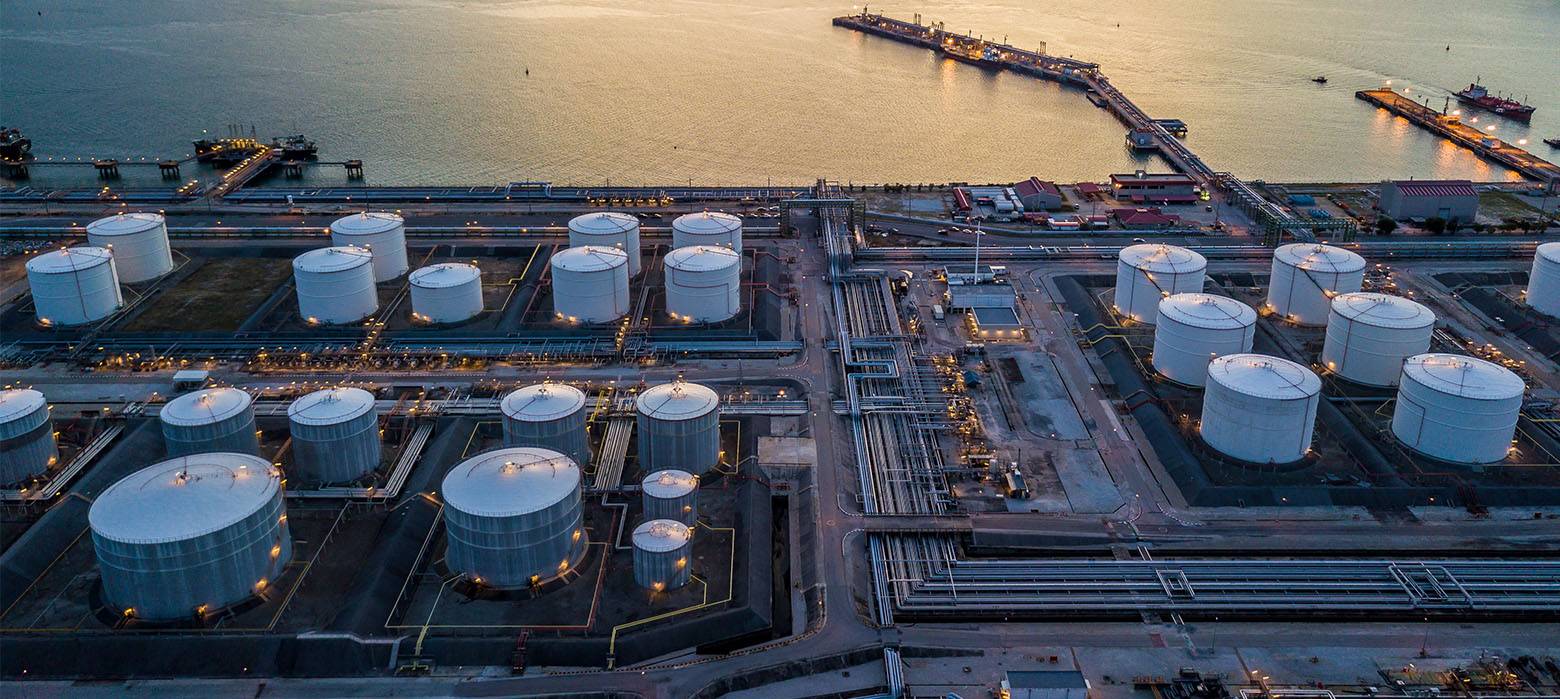
3 Common Industrial Storage Tanks to Know About
Industrial storage tanks help facilities store liquids and gases safely.
However, different products need different tank designs. The right choice depends on the material, storage volume, pressure, temperature, and operating environment.
Among the many industrial tank designs available, three important types are internal floating roof tanks, external floating roof tanks, and bullet tanks.
Each tank has a different design and purpose. Therefore, understanding the differences can help you make a better storage decision.
What Are the Three Common Types of Industrial Storage Tanks?
The three tank types covered in this guide are:
- Internal floating roof tanks (IFR)
- External floating roof tanks (EFR)
- Bullet tanks
The first two are commonly used for large-volume liquid storage. Bullet tanks, however, are designed for pressurized storage applications.
Let’s look at each type.
1. Internal Floating Roof Tanks
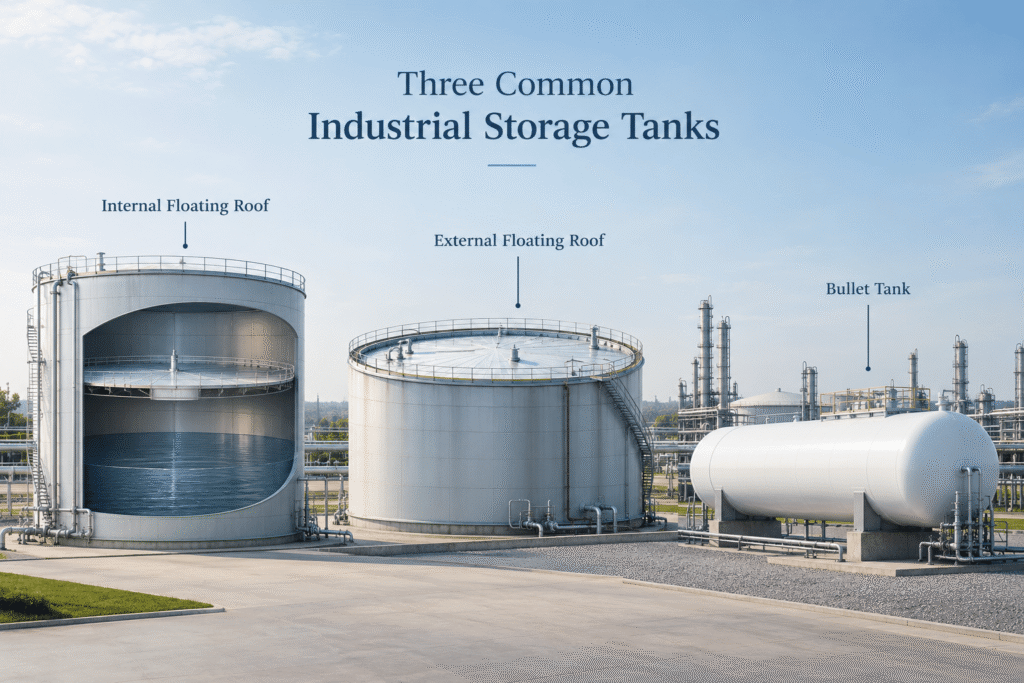
An internal floating roof tank has a fixed outer roof and a floating roof inside the tank.
The internal roof rests on the stored liquid. As the liquid level changes, the roof moves with it.
This design reduces the vapor space above the liquid. As a result, it can help reduce evaporation losses and limit contact between the stored product and outside air.
Internal floating roof tanks can suit many industrial liquid-storage applications. They are often considered for petroleum products, fuels, solvents, and certain chemicals.
How Does an Internal Floating Roof Tank Work?
The floating roof moves as the liquid level rises or falls.
When the tank fills, the roof rises.
When the liquid level drops, the roof moves down.
Therefore, the roof stays close to the liquid surface during normal operation.
This design can provide several benefits:
- Reduced vapor space
- Lower evaporation losses in suitable applications
- Reduced exposure to outside air
- Additional protection for the stored product
- Efficient use of storage volume
However, the exact design should match the stored material and operating conditions.
When Should You Consider an Internal Floating Roof Tank?
An internal floating roof tank may be worth considering when vapor control is important.
It can also be useful when the stored product benefits from reduced exposure to air.
However, tank selection should not rely on tank type alone. You should also evaluate the product, temperature, capacity, material compatibility, and applicable design requirements.
2. External Floating Roof Tanks
An external floating roof tank has a floating roof that sits directly on the stored liquid.
Unlike an internal floating roof tank, the floating roof is exposed to the outdoor environment.
The roof rises and falls with the liquid level. Therefore, it follows changes in the amount of product inside the tank.
External floating roof tanks are commonly associated with large-volume storage. Applications can include crude oil, diesel, kerosene, and other petroleum products, depending on the project requirements.
What Are the Benefits of an External Floating Roof Tank?
An external floating roof can provide several advantages:
- Large storage capacity
- Reduced vapor space above the liquid
- Potentially lower evaporation losses
- Floating roof movement with liquid levels
- Practical design for certain large-volume applications
However, the exposed roof also faces weather conditions.
Therefore, the design should account for factors such as wind, rain, temperature, drainage, and other environmental conditions.
Internal vs. External Floating Roof Tanks
The main difference is simple.
An internal floating roof tank has a fixed outer roof above the floating roof.
An external floating roof tank has a floating roof exposed to the outside environment.
The better choice depends on the product, operating conditions, emissions requirements, environmental exposure, and project specifications.
3. Bullet Tanks
Bullet tanks are cylindrical pressure vessels designed for pressurized storage.
They can be installed horizontally or vertically. Their rounded ends help the vessel handle internal pressure.
Bullet tanks are commonly used for liquefied gases and other products that require pressure-rated storage.
Depending on the application, stored products can include propane, butane, ammonia, and other liquefied gases.
What Are the Benefits of Bullet Tanks?
Bullet tanks can offer several advantages:
- Designed for pressurized storage
- Available in horizontal and vertical configurations
- Suitable for certain liquefied gases
- Available in different capacities
- Efficient use of space for specific applications
Because bullet tanks operate under pressure, engineering and fabrication requirements are especially important.
The vessel must match the product, pressure, temperature, capacity, and applicable standards.
Industrial Storage Tank Comparison
The three tank types serve different purposes.
| Tank Type | Basic Design | Typical Applications | Key Consideration |
|---|---|---|---|
| Internal floating roof | Fixed outer roof with internal floating roof | Fuels, petroleum products, solvents, certain chemicals | Vapor control and product protection |
| External floating roof | Floating roof exposed to the environment | Crude oil, diesel, kerosene, large-volume liquids | Large capacity and environmental exposure |
| Bullet tank | Cylindrical pressure vessel | Liquefied gases and pressurized products | Pressure, temperature, and material requirements |
These are general applications. The actual tank design should always match the project.
How Do You Choose the Right Industrial Storage Tank?
Choosing a tank involves more than selecting a size.
First, identify exactly what the tank will store.
Then, review the operating conditions.
Consider these factors:
- Stored material
- Chemical concentration
- Required capacity
- Operating temperature
- Operating pressure
- Material compatibility
- Corrosion risk
- Installation location
- Maintenance requirements
- Applicable standards
- Expected service life
- Total lifecycle cost
For example, a tank for a corrosive chemical may need a different material or protective system than a tank used for water.
Likewise, a pressurized gas requires a different design from an atmospheric liquid-storage application.
1. Identify the Stored Product
Start with the product.
Know its chemical properties and storage requirements.
If you are storing a chemical, also consider its concentration and temperature.
This information helps narrow down suitable tank materials and designs.
2. Determine the Required Capacity
Next, determine how much product the tank needs to hold.
Do not simply select the largest available tank.
Instead, consider current demand, operating capacity, maximum fill level, expansion, and future requirements.
GSC Tanks also provides resources on industrial storage tank capacity calculations, which can help during the planning stage.
3. Evaluate Material Compatibility
Material selection is critical.
Different products can react differently with steel, stainless steel, fiberglass, polyethylene, and other materials.
Therefore, never assume that one tank material works for every chemical.
GSC Tanks offers tanks in several materials, including HDPE/polyethylene, fiberglass, steel, stainless steel, alloy, and reinforced concrete.
For chemical applications, review the product’s compatibility with the proposed tank material before making a final decision.
4. Consider Corrosion Protection
Some stored products can attack the tank surface.
In these cases, the tank may need a suitable coating or lining.
For example, an appropriate industrial tank lining can create a protective barrier between the stored material and the tank surface. However, the lining must match the chemical, temperature, and operating conditions.
5. Review Applicable Standards
Industrial tanks may need to meet specific codes, standards, or project specifications.
The applicable requirements depend on the tank type and application.
For example, GSC Tanks supplies steel and alloy tanks manufactured to ASME, API, and UL specifications for certain atmospheric and pressure applications.
Therefore, identify the applicable requirements before finalizing the design.
6. Compare Total Lifecycle Cost
The lowest purchase price is not always the best value.
Instead, consider the complete lifecycle cost.
This may include:
- Initial tank cost
- Transportation
- Installation
- Coatings or linings
- Inspection
- Maintenance
- Repairs
- Downtime
- Expected service life
- Future replacement
For example, GSC Tanks’ comparison of carbon steel and stainless steel storage tanks explains why material selection should consider corrosion, maintenance, operating conditions, and lifecycle cost rather than purchase price alone.
Why Does Tank Material Matter?
Tank material directly affects performance.
For example, carbon steel can provide high strength and fabrication flexibility. It can also be an economical option for many large storage applications.
However, carbon steel can corrode in certain environments.
Stainless steel can provide greater corrosion resistance in many applications. However, the correct grade still needs to match the stored material and operating conditions.
Other applications may call for fiberglass, polyethylene, alloy, or reinforced concrete.
Therefore, the best material depends on the complete application.
What Industries Use Industrial Storage Tanks?
Industrial storage tanks serve many industries.
Common applications include:
- Chemical processing
- Food and beverage
- Power generation
- Mining
- Agriculture
- Pulp and paper
- Municipal water
- Wastewater treatment
- Fuel storage
- Industrial processing
GSC Tanks supplies engineered storage tanks, vessels, and silos for industrial, agricultural, and municipal applications. Its product range includes field-erected tanks, steel and alloy tanks, fiberglass tanks, and polyethylene tanks.
Frequently Asked Questions
What are the three common industrial storage tanks?
The three types discussed in this guide are internal floating roof tanks, external floating roof tanks, and bullet tanks.
What is an internal floating roof tank?
An internal floating roof tank has a fixed outer roof and a floating roof inside the tank. The floating roof moves with the liquid level and can help reduce vapor space.
What is an external floating roof tank?
An external floating roof tank has a floating roof that sits on the stored liquid and remains exposed to the outdoor environment.
What are bullet tanks used for?
Bullet tanks are pressure vessels used for pressurized storage. They are commonly considered for liquefied gases and other products that require pressure-rated storage.
What is the difference between an internal and external floating roof tank?
The main difference is the roof arrangement. An internal floating roof tank has a fixed outer roof. An external floating roof tank has a floating roof exposed to the environment.
How do I choose the right industrial storage tank?
Start with the stored material, required capacity, temperature, pressure, corrosion risk, material compatibility, applicable standards, installation conditions, and lifecycle cost.
Does every industrial storage tank need a lining?
No. Some tank materials may provide sufficient resistance for a particular application. However, other applications may require a protective lining or coating.
Final Takeaway
Industrial storage tanks are not one-size-fits-all solutions.
Internal floating roof tanks, external floating roof tanks, and bullet tanks each serve different purposes.
Therefore, start with the application.
Identify the stored product. Then evaluate capacity, pressure, temperature, material compatibility, corrosion risk, standards, and lifecycle cost.
Most importantly, select the tank based on the actual operating conditions rather than price alone.
With the right design and material, an industrial storage tank can provide reliable service and support safe, efficient operations for years to come.
If you are planning a new storage project or replacing an existing tank, GSC Tanks can help you evaluate storage tank options based on your application and project requirements.
- 3 Common Industrial Storage Tanks
Category
- Above Ground Fuel Tanks
- Above Ground Gas Storage Tank
- Above Ground Storage Tanks
- Above Ground Water Storage Tanks
- Agricultural Tanks
- Chemical storage Tanks
- Diesel Fuel Storage Tanks
- Diesel Storage Tanks
- Exernal FloatingRoof Tanks
- Farm Water Tank
- Fiberglass Oil Tanks
- Fiberglass Septic Tanks
- Fiberglass Tanks
- Fiberglass Underground Fuel Storage Tanks
- Field Erected Tanks
- Floating Roof Tank
- Food and Beverage Tanks
- Fuel tank
- Industrial Chemical Storage Tanks
- Industrial Gas Tanks
- Industrial Hot Water Storage Tanks
- industrial hot water tank
- Industrial Plastic Tanks
- Industrial Storage Tanks
- Industrial Tank heating pads
- industrial tanks
- Natural gas
- Natural gas vs Propane
- oil storage tank
- Oil Storage Tanks
- Peracitic Acid
- Petroleum Tanks
- Residential gasoline storage tanks
- Residential Water Storage Tanks
- Sodium Hydroxide Storage Requirements
- Sodium Hypochlorite Storage Tanks
- Steel Storage Tanks
- storage tank failure prevention
- Storage Tanks
- Sulfuric Acid Tanks
- Uncategorized
- UnderGround Storage Tanks
- Waste water tank
- Water Storage Tanks