
Detailed Comparison Between FRP and Polyethylene Tanks
Choosing between FRP and polyethylene tanks requires more than comparing the material price. Although both materials provide excellent corrosion resistance, they perform differently under various industrial conditions.
Therefore, engineers and facility managers should evaluate factors such as chemical compatibility, operating temperature, mechanical strength, tank size, maintenance requirements, and total lifecycle cost before making a final decision.
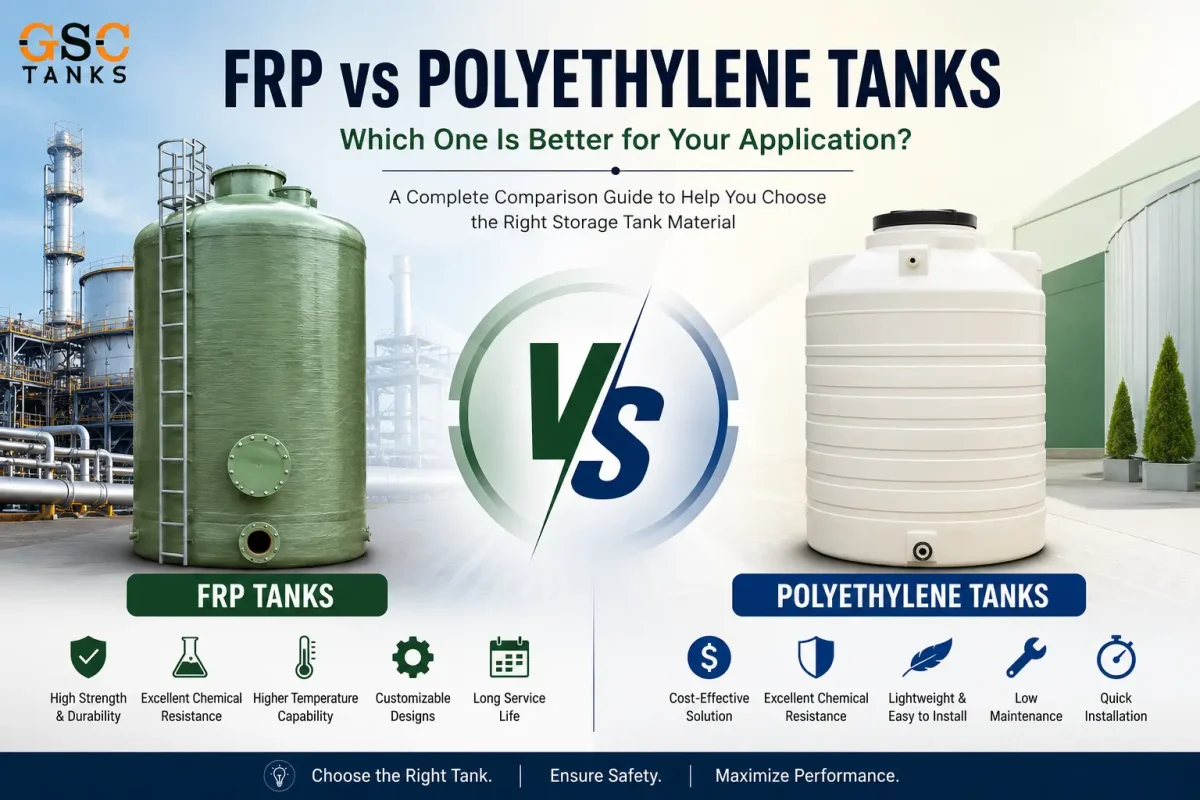
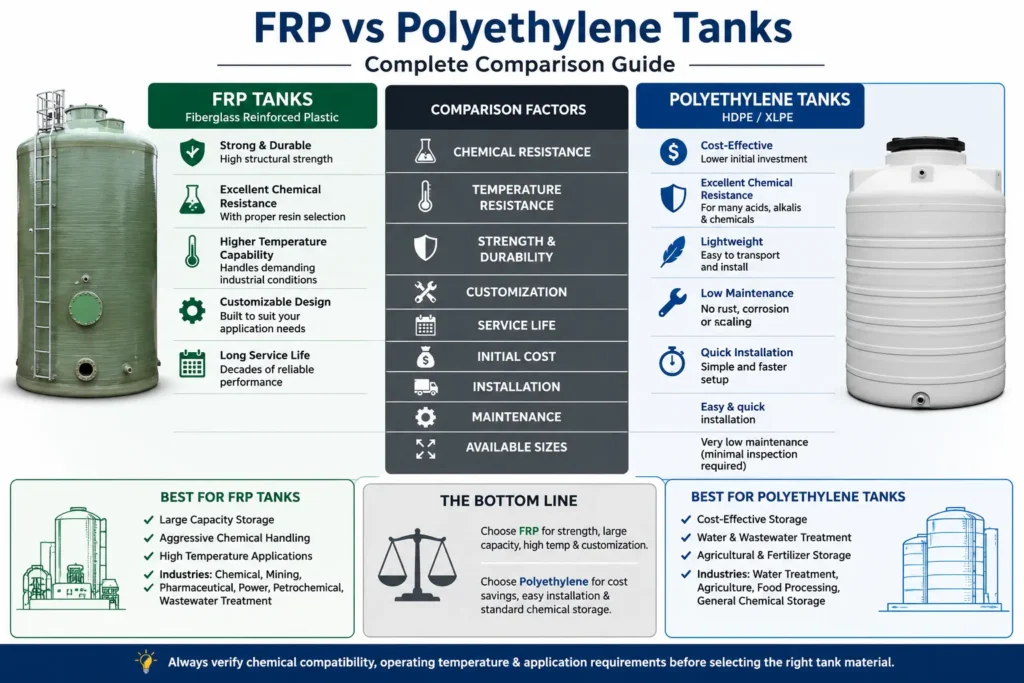
FRP vs Polyethylene Tanks: Complete Comparison
| Comparison Factor | FRP Tanks | Polyethylene Tanks |
|---|---|---|
| Full Name | Fiberglass Reinforced Plastic | High-Density Polyethylene (HDPE) / Crosslinked Polyethylene (XLPE) |
| Construction | Fiberglass reinforcement combined with resin | Molded polyethylene polymer |
| Chemical Resistance | Excellent with proper resin selection | Excellent for many chemicals |
| Mechanical Strength | Higher structural strength | Good impact resistance |
| Temperature Resistance | Generally higher | Lower compared with FRP |
| Large Capacity Tanks | Excellent choice | Limited for very large tanks |
| Custom Fabrication | Highly customizable | Limited customization |
| Weight | Lightweight compared with steel | Extremely lightweight |
| Installation | Requires experienced handling | Simple and quick installation |
| Repairability | Can often be repaired professionally | Repair options are more limited |
| Initial Cost | Higher | Lower |
| Service Life | Long with proper design | Long under suitable conditions |
| Best Applications | Large industrial chemical storage | Standard chemical and water storage |
Chemical Resistance: FRP vs Polyethylene Tanks
Chemical compatibility is one of the most important factors when selecting a storage tank.
Both FRP and polyethylene tanks provide excellent corrosion resistance. However, their performance depends on the chemical being stored.
FRP Chemical Resistance
FRP tanks achieve chemical resistance through the selection of specialized resin systems.
Common resin types include:
- Vinyl ester resin
- Epoxy resin
- Polyester resin
Each resin provides different levels of resistance against acids, solvents, oxidizers, and alkaline chemicals.
For example:
- Vinyl ester FRP tanks often perform well in aggressive chemical environments.
- Polyester FRP tanks may work well for less demanding applications.
- Epoxy systems may be selected for specialized requirements.
Therefore, FRP tank design should always consider:
- Chemical concentration
- Operating temperature
- Exposure duration
- Chemical mixture characteristics
Polyethylene Chemical Resistance
Polyethylene tanks naturally resist many corrosive chemicals because polyethylene is chemically stable and does not rust or corrode.
Common chemicals stored in polyethylene tanks include:
- Sodium hypochlorite
- Hydrochloric acid
- Sodium hydroxide
- Fertilizer solutions
- Water treatment chemicals
However, polyethylene does not perform equally well with every chemical.
For example, certain solvents and hydrocarbons may affect polyethylene over time.
Consequently, chemical compatibility verification remains essential.
Which Has Better Chemical Resistance: FRP or Polyethylene?
There is no universal winner.
The better choice depends on the chemical.
Choose FRP when:
- The chemical environment is highly aggressive.
- The chemical requires a specialized resin system.
- The tank requires high structural strength.
- The storage capacity is large.
Choose Polyethylene when:
- The chemical is compatible with HDPE or XLPE.
- The application involves standard industrial chemicals.
- Cost efficiency is important.
- The operating conditions are moderate.
Temperature Resistance Comparison
Temperature plays a major role in tank performance.
A material that performs well at ambient temperature may experience reduced service life when exposed to elevated temperatures.
FRP Temperature Performance
FRP tanks generally provide better temperature resistance because manufacturers can select resin systems designed for higher-temperature applications.
Depending on the resin and design, FRP tanks can support demanding industrial environments.
Applications may include:
- Chemical processing
- Power generation
- Industrial wastewater
- Manufacturing processes
However, temperature limits must always be verified with the tank manufacturer.
Polyethylene Temperature Performance
Polyethylene tanks perform well in many ambient-temperature applications.
However, high temperatures can affect:
- Structural rigidity
- Dimensional stability
- Long-term service life
Therefore, polyethylene tanks are typically selected for applications where operating temperatures remain within the recommended range.
Which Handles Temperature Better?
In most industrial applications:
Winner: FRP Tanks
FRP generally provides better performance when:
- Temperatures are elevated.
- Chemical exposure is aggressive.
- Structural requirements are demanding.
However, polyethylene remains an excellent option for applications operating under suitable temperature conditions.
Strength and Durability Comparison
Tank strength becomes increasingly important as tank capacity increases.
Large industrial tanks must withstand:
- Liquid weight
- Wind loads
- Transportation stresses
- Installation forces
- Long-term operating conditions
FRP Tank Strength
FRP tanks provide excellent mechanical strength because fiberglass reinforcement creates a strong structural framework.
Advantages include:
- High strength-to-weight ratio
- Better rigidity
- Custom wall thickness
- Ability to manufacture large tanks
Therefore, FRP is commonly selected for large industrial storage systems.
Polyethylene Tank Strength
Polyethylene tanks provide excellent impact resistance.
Because polyethylene is flexible, it can absorb certain impacts without cracking.
This makes polyethylene useful for:
- Agricultural applications
- Water treatment chemicals
- Smaller industrial storage systems
However, polyethylene generally has lower structural rigidity compared with FRP.
Which Is More Durable?
For demanding industrial applications:
FRP generally provides higher structural durability.
For economical chemical storage:
Polyethylene provides reliable long-term performance.
The correct choice depends on the application requirements.
Lifespan Comparison
Both FRP and polyethylene tanks can provide many years of service when properly selected and maintained.
However, lifespan depends on:
- Chemical exposure
- Temperature
- Installation quality
- UV exposure
- Maintenance practices
- Operating conditions
FRP Tank Lifespan
FRP tanks can provide decades of service when:
- The correct resin is selected.
- The tank is properly designed.
- Operators follow inspection procedures.
Because FRP tanks are engineered solutions, they often perform well in demanding industrial environments.
Polyethylene Tank Lifespan
Polyethylene tanks also provide excellent service life.
Their lifespan depends heavily on:
- Chemical compatibility
- UV protection
- Temperature exposure
- Mechanical handling
For many standard chemical storage applications, polyethylene tanks provide years of reliable operation.
Maintenance Requirements: FRP vs Polyethylene
Both tank materials require relatively low maintenance compared with traditional steel tanks.
However, inspection practices differ.
FRP Tank Maintenance
Operators should inspect:
- Exterior surfaces
- Fiberglass condition
- Connections
- Nozzles
- Signs of chemical attack
Regular inspections help identify:
- Surface damage
- Resin degradation
- Structural concerns
Polyethylene Tank Maintenance
Operators should inspect:
- Tank walls
- Fittings
- Connections
- Signs of stress cracking
- UV exposure effects
Because polyethylene tanks are flexible, operators should also verify that the tank remains properly supported.
Installation Comparison
FRP Tank Installation
FRP tanks often require more planning because they may involve:
- Larger dimensions
- Custom designs
- Special lifting requirements
- Engineering review
However, professional installation ensures long-term performance.
Polyethylene Tank Installation
Polyethylene tanks are generally easier to install because they are:
- Lightweight
- Easy to transport
- Simple to position
As a result, smaller facilities often prefer polyethylene tanks for faster installation.
Which Tank Is Better: FRP or Polyethylene?
The answer depends on your application.
Choose FRP Tanks If You Need:
✅ Large storage capacity
✅ Higher temperature resistance
✅ Custom engineering
✅ Strong structural performance
✅ Aggressive chemical handling
✅ Long-term industrial service
Choose Polyethylene Tanks If You Need:
✅ Cost-effective storage
✅ Excellent corrosion resistance
✅ Easy installation
✅ Standard chemical storage
✅ Lightweight construction
✅ Moderate operating conditions
Final Recommendation
FRP and polyethylene tanks are both excellent solutions for industrial storage applications. However, they serve different purposes.
FRP tanks are generally the better choice for large-scale industrial operations, demanding chemical environments, and applications requiring high structural strength.
Polyethylene tanks are generally the better choice for economical chemical storage, water treatment applications, and facilities requiring simple, reliable corrosion-resistant tanks.
Therefore, the best tank material is not always the most expensive option. The right choice is the material that matches your chemical, temperature, capacity, and operational requirements.
Applications, Cost Comparison, Pros & Cons, and Selection Guide
The best storage tank material depends on where and how the tank will be used. While FRP and polyethylene tanks both provide corrosion resistance, each material performs better in specific industries and operating environments.
Therefore, before selecting a tank, companies should evaluate the chemical properties, storage volume, temperature conditions, regulatory requirements, and expected service life.
FRP vs Polyethylene Tanks by Industry
Different industries have different storage challenges. Some applications require maximum chemical resistance, while others prioritize affordability and easy installation.
1. Chemical Processing Industry
Chemical processing facilities often handle aggressive acids, alkalis, solvents, and specialty chemicals.
These environments require tanks that can withstand:
- Corrosive chemicals
- Continuous exposure
- Temperature variations
- Long operating cycles
FRP Tanks for Chemical Processing
FRP tanks are widely used in chemical plants because they offer:
- Excellent corrosion resistance
- High structural strength
- Custom resin options
- Large capacity capabilities
Common applications include:
- Acid storage
- Alkali storage
- Process chemicals
- Chemical mixing systems
- Waste treatment chemicals
Polyethylene Tanks for Chemical Processing
Polyethylene tanks are also suitable for many chemical applications, especially when operating conditions are moderate.
Common uses include:
- Sodium hypochlorite storage
- Water treatment chemicals
- Cleaning solutions
- Fertilizer chemicals
However, facilities should verify chemical compatibility before selecting polyethylene for aggressive chemicals.
2. Water and Wastewater Treatment
Water treatment facilities commonly store chemicals such as:
- Sodium hypochlorite
- Ferric chloride
- Alum
- Sodium hydroxide
- Chlorine solutions
Which Tank Is Better for Water Treatment?
Both materials work well.
However:
Polyethylene tanks are often preferred for:
- Small to medium chemical storage
- Chemical dosing systems
- Municipal water treatment applications
FRP tanks are often preferred for:
- Larger storage volumes
- More demanding chemical environments
- Industrial wastewater facilities
Therefore, the correct choice depends on the facility size and chemical requirements.
3. Food and Beverage Industry
Food processing facilities require materials that maintain product quality and meet hygiene expectations.
FRP Tanks
FRP tanks may be used for:
- Process water
- Waste handling
- Industrial chemicals
However, the resin system must be carefully selected.
Polyethylene Tanks
Polyethylene tanks are commonly used for:
- Water storage
- Cleaning chemicals
- Food-grade liquid storage
When required, manufacturers can provide food-compatible polyethylene materials.
4. Mining Industry
Mining operations often handle highly corrosive materials, including:
- Acids
- Mineral processing chemicals
- Leaching solutions
Because mining environments are demanding, tanks must withstand:
- Harsh chemicals
- Outdoor exposure
- Large storage requirements
Best Choice for Mining Applications:
In many mining applications, FRP tanks are preferred because they provide:
- Higher structural strength
- Better customization
- Large capacity options
- Long service life
However, polyethylene tanks may still be suitable for less aggressive chemical storage.
5. Agriculture Industry
Agricultural operations commonly store:
- Fertilizers
- Liquid nutrients
- Crop treatment chemicals
Polyethylene Tanks
Polyethylene is often the preferred choice because it provides:
- Affordable storage
- Easy installation
- Chemical resistance
- Lightweight handling
For many agricultural applications, polyethylene provides excellent value.
FRP vs Polyethylene Tank Cost Comparison
Cost is an important factor, but the lowest initial price does not always provide the lowest overall cost.
Companies should consider:
- Purchase price
- Installation cost
- Maintenance requirements
- Replacement frequency
- Operational reliability
Initial Purchase Cost
Polyethylene Tanks
Polyethylene tanks usually have a lower initial cost because:
- Manufacturing is simpler
- Production is faster
- Material costs are lower
Therefore, they are often selected for standard storage applications.
FRP Tanks
FRP tanks generally have a higher initial cost because:
- Manufacturing requires specialized processes
- Resin selection affects pricing
- Engineering requirements may increase costs
However, the additional investment often provides advantages in demanding applications.
Long-Term Cost Considerations
A cheaper tank may not always be the most economical option.
For example:
A polyethylene tank may have a lower upfront price. However, if an application requires:
- Higher temperature resistance
- Large capacity
- Specialized chemical compatibility
an FRP tank may provide better long-term value.
Similarly, selecting an FRP tank for a simple chemical storage application may increase unnecessary costs.
Therefore, companies should evaluate total cost of ownership rather than only purchase price.
FRP Tanks: Advantages and Disadvantages
Advantages of FRP Tanks
Excellent Corrosion Resistance
FRP tanks resist many aggressive chemicals when designed with the correct resin system.
High Strength
Fiberglass reinforcement provides excellent structural performance.
Large Capacity Options
FRP tanks can be manufactured for large industrial storage requirements.
Custom Designs
Manufacturers can customize:
- Dimensions
- Connections
- Internal linings
- Reinforcement
- Tank configuration
Better Temperature Performance
FRP generally performs better in higher-temperature applications.
Disadvantages of FRP Tanks
Higher Initial Investment
FRP tanks typically cost more than standard polyethylene tanks.
Requires Proper Engineering
Incorrect resin selection or poor fabrication can affect performance.
Professional Installation Recommended
Large FRP tanks often require experienced handling and installation.
Polyethylene Tanks: Advantages and Disadvantages
Advantages of Polyethylene Tanks
Cost Effective
Polyethylene provides reliable performance at an economical price.
Excellent Chemical Resistance
Many acids, alkalis, and water treatment chemicals are compatible with polyethylene.
Lightweight
Installation and transportation are easier compared with heavier materials.
Low Maintenance
Polyethylene does not rust or corrode.
Fast Installation
Most polyethylene tanks require minimal installation complexity.
Disadvantages of Polyethylene Tanks
Limited High-Temperature Performance
Polyethylene generally cannot handle temperatures as high as many FRP systems.
Lower Structural Rigidity
Compared with FRP, polyethylene has less structural strength.
Limited Customization
Polyethylene tanks are usually available in standard shapes and sizes.
Decision Guide: How to Choose Between FRP and Polyethylene Tanks
Use this simple decision process:
Choose FRP Tanks When:
✔ You need large-capacity storage
✔ The chemical environment is highly aggressive
✔ Operating temperatures are higher
✔ Custom engineering is required
✔ Long-term industrial durability is important
✔ The tank will operate in demanding conditions
Choose Polyethylene Tanks When:
✔ The application involves compatible chemicals
✔ Cost efficiency is important
✔ The storage requirement is moderate
✔ Quick installation is needed
✔ The operating temperature is controlled
✔ Lightweight construction is preferred
FRP vs Polyethylene Tanks: Quick Decision Table
| Requirement | Better Choice |
|---|---|
| Lowest initial cost | Polyethylene |
| Large industrial tanks | FRP |
| High chemical exposure | FRP |
| Standard chemical storage | Polyethylene |
| Higher temperature applications | FRP |
| Easy transportation | Polyethylene |
| Custom tank design | FRP |
| Water treatment chemicals | Both |
| Agricultural chemicals | Polyethylene |
| Mining applications | FRP |
Expert Recommendation
There is no single “best” tank material for every industrial application.
Instead, the right choice depends on:
- The chemical being stored
- Chemical concentration
- Operating temperature
- Storage capacity
- Installation environment
- Required service life
FRP and polyethylene tanks both provide reliable performance when properly selected.
The key is matching the tank material with the actual operating conditions.
Frequently Asked Questions About FRP vs Polyethylene Tanks
1. Are FRP tanks better than polyethylene tanks?
FRP tanks are better than polyethylene tanks for applications that require higher structural strength, larger storage capacity, higher temperature resistance, and customized designs.
However, polyethylene tanks are often the better choice for standard chemical storage applications because they offer excellent chemical resistance, lower cost, and easier installation.
The better option depends on the chemical, operating conditions, and storage requirements.
2. What is the difference between FRP and polyethylene tanks?
The primary difference is the material construction.
FRP tanks use fiberglass reinforcement combined with resin to create a strong, corrosion-resistant structure.
Polyethylene tanks use high-density polyethylene (HDPE) or crosslinked polyethylene (XLPE), which provides excellent chemical resistance and lightweight construction.
FRP focuses more on structural strength and customization, while polyethylene focuses more on affordability and chemical resistance.
3. Which tank material is better for chemical storage?
Both FRP and polyethylene tanks can be suitable for chemical storage.
However, the correct choice depends on the chemical properties.
FRP tanks are often preferred for:
- Aggressive chemicals
- Large storage volumes
- Higher temperature applications
- Custom industrial systems
Polyethylene tanks are commonly selected for:
- Water treatment chemicals
- Fertilizers
- Sodium hypochlorite
- Moderate-temperature chemical storage
Always verify compatibility with the specific chemical concentration and operating temperature.
4. Are FRP tanks more durable than polyethylene tanks?
In demanding industrial environments, FRP tanks generally provide greater structural durability because fiberglass reinforcement improves strength and rigidity.
However, polyethylene tanks provide excellent impact resistance and corrosion protection.
Therefore, durability depends on the application conditions rather than the material alone.
5. Which tank lasts longer: FRP or polyethylene?
Both FRP and polyethylene tanks can provide many years of service when properly selected and maintained.
FRP tanks often provide longer service life in demanding industrial environments because they offer:
- Higher structural strength
- Better temperature performance
- Custom engineering options
Polyethylene tanks also provide long service life when used within their recommended chemical and temperature limits.
6. Are polyethylene tanks chemical resistant?
Yes. Polyethylene tanks provide excellent resistance to many acids, alkalis, and industrial chemicals.
Common chemicals stored in polyethylene tanks include:
- Sodium hypochlorite
- Hydrochloric acid
- Sodium hydroxide
- Fertilizer solutions
However, compatibility should always be confirmed because certain solvents and chemicals may affect polyethylene performance.
7. Can FRP tanks store corrosive chemicals?
Yes. FRP tanks are widely used for corrosive chemical storage.
The performance of an FRP tank depends on selecting the correct:
- Resin system
- Reinforcement design
- Tank thickness
- Operating conditions
FRP tanks are commonly used in industries such as:
- Chemical processing
- Mining
- Wastewater treatment
- Power generation
8. Which tank is cheaper: FRP or polyethylene?
Polyethylene tanks usually have a lower initial purchase cost.
They are economical because:
- Manufacturing is faster
- Material costs are lower
- Installation is simpler
However, FRP tanks may provide better long-term value for demanding applications because of their strength, customization options, and extended service capabilities.
9. Can FRP and polyethylene tanks be used outdoors?
Yes, both materials can be used outdoors when properly designed.
Outdoor installations should consider:
- UV exposure
- Weather conditions
- Temperature changes
- Support requirements
Manufacturers may recommend UV-resistant materials or protective solutions depending on the installation environment.
10. How do I choose between an FRP tank and a polyethylene tank?
To select the correct tank, evaluate:
- Chemical compatibility
- Chemical concentration
- Operating temperature
- Storage capacity
- Installation location
- Required service life
- Industry regulations
A professional tank manufacturer can help evaluate these factors and recommend the appropriate material.
Final Verdict: FRP vs Polyethylene Tanks
Both FRP and polyethylene tanks provide reliable solutions for industrial storage applications.
However, they serve different purposes.
FRP Tanks Are the Better Choice When You Need:
- Large-capacity storage
- Higher structural strength
- Custom engineering
- Aggressive chemical handling
- Higher operating temperatures
- Long-term industrial performance
Polyethylene Tanks Are the Better Choice When You Need:
- Cost-effective storage
- Excellent corrosion resistance
- Lightweight installation
- Standard chemical storage
- Moderate operating conditions
- Simple maintenance
Ultimately, the best storage tank is the one that matches your specific application requirements.
Selecting the correct material during the design stage helps companies reduce maintenance costs, improve safety, and achieve longer equipment life.
Need help selecting the right storage tank material? Contact GSC Tanks to discuss your chemical compatibility, capacity, and application requirements with our tank specialists.
