

- GSC Tanks
- August 8, 2026
Carbon Steel vs. Stainless Steel Tanks
Choosing the right material is one of the most important steps when planning an industrial storage tank.
Two common options are carbon steel and stainless steel. Both materials offer excellent strength and durability. However, they perform differently in certain environments.
So, which one should you choose?
The answer depends on several factors. These include the stored product, corrosion risk, operating temperature, maintenance needs, budget, and expected service life.
In this guide, we compare carbon steel and stainless steel storage tanks. We also explain where each material works best.
Carbon Steel vs. Stainless Steel: The Short Answer
Carbon steel is often a cost-effective choice for many industrial storage applications. Stainless steel is often a better choice when corrosion resistance, cleanliness, or demanding service conditions are important.
However, neither material is right for every application.
Before making a decision, consider:
- What will the tank store?
- What is the chemical concentration?
- What temperature will the tank handle?
- Will the tank face a corrosive environment?
- What capacity do you need?
- What maintenance will the tank require?
- Which standards apply?
- What is the expected service life?
- What is the total lifecycle cost?
The lowest initial price is not always the lowest long-term cost.
What Is a Carbon Steel Storage Tank?
Carbon steel is a common material for industrial storage tanks. It offers high strength and good fabrication flexibility.
It can also provide an economical solution for large storage applications.
Carbon steel tanks can be used in many industrial environments. However, the material can corrode when exposed to moisture, chemicals, oxygen, salts, and other corrosive agents.
Therefore, the tank may require additional corrosion protection.
Depending on the application, this can include:
- Protective coatings
- Internal linings
- Corrosion allowances
- Cathodic protection
- Regular inspection
- Other corrosion-control methods
The exact protection system depends on the stored product and operating environment.
What Is a Stainless Steel Storage Tank?
Stainless steel contains chromium and other alloying elements. These elements help the steel resist corrosion.
As a result, stainless steel can perform well in many demanding environments.
It is also widely used where cleanliness and product purity matter.
Stainless steel can be a good option for applications that require:
- High corrosion resistance
- Cleanable surfaces
- Product purity
- Sanitary conditions
- Resistance to certain chemicals
- Reduced corrosion-related maintenance
However, stainless steel is not corrosion-proof.
Different stainless steel grades have different properties. Therefore, the correct grade must match the application.
Carbon Steel vs. Stainless Steel Storage Tanks
The two materials have different advantages.
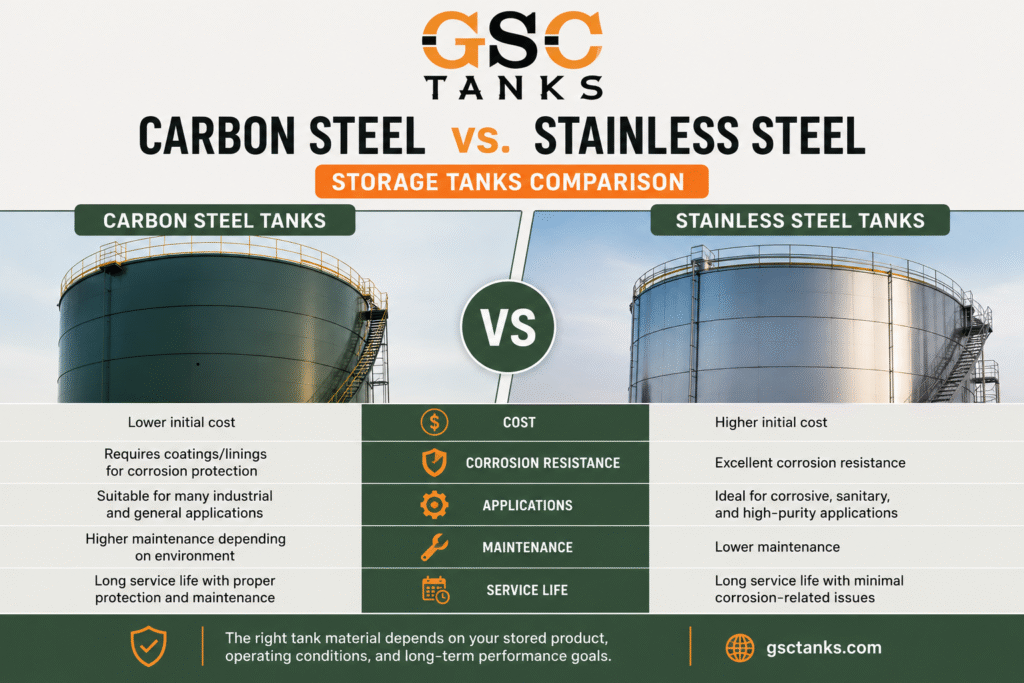
Here is a quick comparison:
| Factor | Carbon Steel | Stainless Steel |
|---|---|---|
| Initial cost | Usually lower | Usually higher |
| Strength | Excellent | Excellent |
| Corrosion resistance | Requires suitable protection in many applications | Generally higher, depending on grade |
| Chemical compatibility | Depends on application and protection | Depends on grade and application |
| Coatings | Often required | May not be required in some applications |
| Maintenance | May require coating or lining maintenance | Often lower corrosion-related maintenance |
| Sanitary applications | Application-dependent | Often preferred |
| Product purity | Depends on coating or lining | Can offer advantages |
| Large tanks | Very common | Suitable for many applications |
| Lifecycle cost | Can be very attractive | Can be attractive when corrosion resistance reduces maintenance |
These are general comparisons.
The actual choice should always consider the specific tank application.
1. Corrosion Resistance
Corrosion is one of the biggest differences between the two materials.
Carbon steel can corrode when exposed to moisture and corrosive substances. Therefore, it often needs a suitable protection system.
Stainless steel resists corrosion in many environments. Its chromium content helps create a protective passive layer on the surface.
However, stainless steel is not immune to corrosion.
Certain chemicals and operating conditions can cause:
- Pitting
- Crevice corrosion
- Surface contamination
- Other forms of material degradation
For that reason, the right question is not simply:
“Is stainless steel corrosion resistant?”
Instead, ask:
“Is this specific stainless steel grade suitable for my application?”
That distinction is important.
2. Chemical Compatibility
Chemical compatibility should always be considered before selecting a tank material.
Different chemicals react differently with different materials.
For example, the selection process may need to consider:
- Chemical type
- Chemical concentration
- Operating temperature
- Storage time
- Chemical impurities
- Cleaning chemicals
- Exposure conditions
- Required lining or coating
Carbon steel may work well for certain chemicals when properly protected.
Likewise, stainless steel may work better in other applications.
However, stainless steel is not automatically suitable for every chemical.
The specific grade matters.
3. Initial Cost
Carbon steel usually costs less than stainless steel.
Therefore, carbon steel can be attractive when a project has a strict capital budget.
This becomes especially important for large tanks. Material costs can have a significant impact as tank size increases.
However, the initial purchase price is only one part of the total cost.
You should also consider:
- Shipping
- Installation
- Coatings
- Linings
- Inspection
- Maintenance
- Repairs
- Expected service life
- Future replacement
As a result, a more expensive tank can sometimes provide better long-term value.
4. Maintenance Requirements
Maintenance depends on the tank material and the application.
Carbon steel tanks may require regular inspection of:
- External coatings
- Internal linings
- Weld areas
- Corrosion-prone locations
- Tank surfaces
If the tank uses a protective coating or lining, that system becomes an important part of the maintenance program.
Stainless steel can reduce corrosion-related maintenance in suitable environments.
However, stainless steel still requires proper care.
Surface contamination and unsuitable cleaning practices can affect its performance.
Therefore, both materials require an appropriate inspection and maintenance plan.
5. Strength and Durability
Both carbon steel and stainless steel can provide excellent structural performance.
However, tank durability depends on more than the material.
Engineers may also need to consider:
- Tank size
- Tank diameter
- Tank height
- Wall thickness
- Roof design
- Foundation
- Wind loads
- Seismic loads
- Operating temperature
- Internal pressure
- Corrosion allowance
- Installation conditions
Therefore, it is not accurate to say that one material is always stronger.
Proper engineering is what makes a tank suitable for its intended service.
6. Sanitary and Product-Purity Requirements
Some industries have strict cleanliness requirements.
This is especially important in applications involving:
- Food and beverage
- Pharmaceutical products
- Specialty chemicals
- Other sensitive materials
Stainless steel can offer advantages in these environments.
It can provide a suitable surface for cleaning and sanitation when the correct grade, finish, and fabrication practices are used.
However, the material alone does not guarantee sanitary performance.
The complete tank design matters.
Carbon Steel vs. Stainless Steel for Chemical Storage
Chemical storage requires careful material selection.
Before choosing a tank, identify:
- The chemical
- Concentration
- Temperature
- Storage conditions
- Required capacity
- Expected service life
- Applicable standards
Carbon steel may provide an economical solution for certain chemicals.
A suitable coating or lining can also provide additional protection.
On the other hand, stainless steel may be a better choice for some corrosive or demanding applications.
However, the correct stainless steel grade must still be selected.
Why material selection matters
Choosing the wrong material can lead to:
- Corrosion
- Contamination
- Increased maintenance
- Premature repairs
- Reduced service life
- Unplanned replacement costs
For that reason, chemical compatibility should be evaluated before finalizing the tank design.
GSC Tanks offers several tank materials. These include carbon steel, stainless steel, alloy, fiberglass, polyethylene, and reinforced concrete.
This allows the tank material to be matched to the actual application.
Carbon Steel vs. Stainless Steel for Water Storage
Water storage also requires application-specific planning.
Not all water has the same properties.
For example, a tank may store:
- Process water
- Industrial water
- Municipal water
- Treated water
- Wastewater
- Chemical-treated water
Each application can have different requirements.
Carbon steel can be suitable when the water chemistry and corrosion-protection system support its use.
Stainless steel may offer advantages in environments where greater corrosion resistance is required.
The design should also consider:
- Water chemistry
- Tank capacity
- Environmental exposure
- Cleaning requirements
- Maintenance
- Applicable standards
What About API 650 Steel Storage Tanks?
API 650 is an important standard for many large welded steel storage tanks.
It covers specific aboveground welded storage tank applications.
However, API 650 does not automatically apply to every steel storage tank.
The applicable standard depends on factors such as:
- Tank design
- Operating conditions
- Stored liquid
- Tank configuration
- Pressure
- Project requirements
Therefore, the applicable standard should be confirmed during the engineering stage.
For more information, see GSC Tanks’ resources on steel tank construction and industrial storage applications:
- Discover the Strength of Steel and Reinforced Concrete Tanks
- Steel Storage Tanks: The Cornerstone of Industrial Storage Solutions
When Should You Choose Carbon Steel?
Carbon steel may be the right choice when:
- The stored product is compatible with carbon steel.
- The project requires a cost-effective solution.
- A suitable coating or lining can provide corrosion protection.
- The application does not require higher corrosion resistance.
- Large storage capacity is required.
- The project specifications allow carbon steel.
Carbon steel offers a strong combination of strength, availability, fabrication flexibility, and cost.
For many industrial projects, that combination makes it a practical choice.
When Should You Choose Stainless Steel?
Stainless steel may be a better option when:
- Corrosion resistance is a major concern.
- The stored product creates a demanding environment.
- Product purity is important.
- Sanitary conditions are required.
- Cleaning requirements are demanding.
- Lower corrosion-related maintenance is desirable.
- The selected stainless steel grade is compatible with the stored material.
However, stainless steel has a higher initial cost in many cases.
Therefore, the additional investment should provide a clear benefit for the application.
How to Choose the Right Steel Storage Tank
A simple step-by-step approach can make the decision easier.
Step 1: Identify the stored product
Start with the liquid or material that the tank will store.
Document:
- Product name
- Chemical composition
- Concentration
- Temperature
- Storage conditions
Step 2: Determine the tank capacity
Calculate the required storage volume.
Also consider:
- Operating capacity
- Maximum fill level
- Expansion
- Future capacity needs
Step 3: Evaluate corrosion risk
Determine whether the tank will face:
- Chemicals
- Moisture
- Chlorides
- Outdoor exposure
- High temperatures
- Aggressive cleaning agents
Step 4: Select the appropriate material
Compare:
- Carbon steel
- Stainless steel
- Alloy
- FRP
- Polyethylene
- Other suitable materials
The best material depends on the application.
Step 5: Identify applicable standards
Determine which codes and standards apply to the project.
Depending on the tank and application, these may include:
- API standards
- ASME requirements
- UL requirements
- Project-specific specifications
Step 6: Compare lifecycle costs
Do not compare only the purchase price.
Instead, evaluate:
- Initial cost
- Installation
- Coatings
- Linings
- Maintenance
- Inspection
- Repairs
- Expected service life
- Replacement costs
Step 7: Consult a qualified tank manufacturer
Complex industrial applications require careful engineering.
An experienced tank manufacturer can help evaluate:
- Material compatibility
- Tank configuration
- Design requirements
- Applicable standards
- Fabrication
- Installation considerations
Carbon Steel or Stainless Steel: Which Is Right for You?
There is no single answer.
Carbon steel is often a strong choice when cost, structural strength, and practical corrosion protection are important.
Stainless steel is often a better choice when corrosion resistance, cleanliness, or demanding service conditions justify the higher initial investment.
However, the stored product should always drive the decision.
Before choosing a material, evaluate:
- What you are storing
- How much you need to store
- Operating conditions
- Corrosion risk
- Maintenance requirements
- Applicable standards
- Expected service life
- Total lifecycle cost
This approach helps you choose a tank based on performance rather than price alone.
Frequently Asked Questions
Is carbon steel cheaper than stainless steel?
Yes, carbon steel generally has a lower initial material cost. However, total project cost also includes installation, coatings, maintenance, repairs, and potential replacement.
Is stainless steel better than carbon steel?
Not always. Stainless steel offers greater corrosion resistance in many environments. However, carbon steel can provide excellent performance when the material and protection system match the application.
Which is better for chemical storage?
It depends on the chemical.
Chemical type, concentration, temperature, and operating conditions should all be evaluated before selecting the tank material.
Can carbon steel tanks store water?
Yes. Carbon steel can be used for many water storage applications when the tank design and corrosion-protection system are appropriate.
Are stainless steel tanks corrosion-proof?
No. Stainless steel is corrosion resistant, but it is not corrosion-proof. The correct grade must match the operating environment.
Does API 650 apply to every steel tank?
No. API 650 applies to specific aboveground welded steel storage tank applications. The project requirements should determine which standard applies.
Which tank material has the lowest lifecycle cost?
There is no universal answer.
Carbon steel may have a lower initial cost. Stainless steel may reduce corrosion-related maintenance in some applications.
The best choice depends on the complete lifecycle cost.
Final Takeaway
Carbon steel and stainless steel both have an important role in industrial storage.
Carbon steel often provides an excellent balance of strength, flexibility, and cost.
Stainless steel can provide greater corrosion resistance, cleanliness, and durability in suitable environments.
Therefore, the right choice depends on your specific application.
Start with the stored product. Then evaluate operating conditions, corrosion risk, applicable standards, maintenance, and lifecycle cost.
By following this process, you can select a storage tank that delivers the right combination of performance, reliability, safety, and long-term value.
If you are evaluating a new industrial storage tank, GSC Tanks can help you compare tank materials and configurations based on your project requirements.
Category
- Above Ground Fuel Tanks
- Above Ground Gas Storage Tank
- Above Ground Storage Tanks
- Above Ground Water Storage Tanks
- Agricultural Tanks
- Chemical storage Tanks
- Diesel Fuel Storage Tanks
- Diesel Storage Tanks
- Exernal FloatingRoof Tanks
- Farm Water Tank
- Fiberglass Oil Tanks
- Fiberglass Septic Tanks
- Fiberglass Tanks
- Fiberglass Underground Fuel Storage Tanks
- Field Erected Tanks
- Floating Roof Tank
- Food and Beverage Tanks
- Fuel tank
- Industrial Chemical Storage Tanks
- Industrial Gas Tanks
- Industrial Hot Water Storage Tanks
- industrial hot water tank
- Industrial Plastic Tanks
- Industrial Storage Tanks
- Industrial Tank heating pads
- industrial tanks
- Natural gas
- Natural gas vs Propane
- oil storage tank
- Oil Storage Tanks
- Peracitic Acid
- Petroleum Tanks
- Residential gasoline storage tanks
- Residential Water Storage Tanks
- Sodium Hydroxide Storage Requirements
- Sodium Hypochlorite Storage Tanks
- Steel Storage Tanks
- storage tank failure prevention
- Storage Tanks
- Sulfuric Acid Tanks
- Uncategorized
- UnderGround Storage Tanks
- Waste water tank
- Water Storage Tanks