

- GSC Tanks
- September 9, 2026
How to Calculate Industrial Storage Tank Capacity: A Practical Guide
Choosing the right storage tank starts with one basic question: How much material does the tank need to hold? Industrial storage tank capacity affects tank dimensions, operating efficiency, installation requirements, and project cost. However, calculating capacity is not always as simple as looking at the tank height and diameter.
The calculation depends on the tank shape, dimensions, liquid level, and intended use. In addition, the required capacity may differ from the tank’s actual physical volume.
This guide explains how to calculate industrial tank capacity using common formulas. It also explains the difference between total capacity and working capacity. Finally, it covers the factors that engineers and facility managers should consider before selecting a tank.
What Is Industrial Storage Tank Capacity?
Industrial storage tank capacity is the amount of material a tank can physically contain.
Manufacturers usually express capacity in:
- Gallons
- US gallons
- Liters
- Cubic feet
- Cubic meters
For example, a tank may have a total capacity of 10,000 gallons. However, the recommended operating volume may be lower.
Therefore, it is important to distinguish between total capacity and working capacity.
Total or Gross Capacity
Gross capacity is the maximum geometric volume inside the tank.
It is based mainly on the tank’s internal dimensions and shape.
Working Capacity
Working capacity is the volume that the tank is intended to hold during normal operation.
It may be lower than the gross capacity because of:
- Freeboard
- Expansion requirements
- Operating limits
- Internal equipment
- Sediment space
- Safety requirements
- Liquid-level controls
As a result, a 10,000-gallon tank does not necessarily mean that 10,000 gallons should be loaded during every operating cycle.
How Do You Calculate Tank Capacity?
The basic calculation depends on the tank geometry.
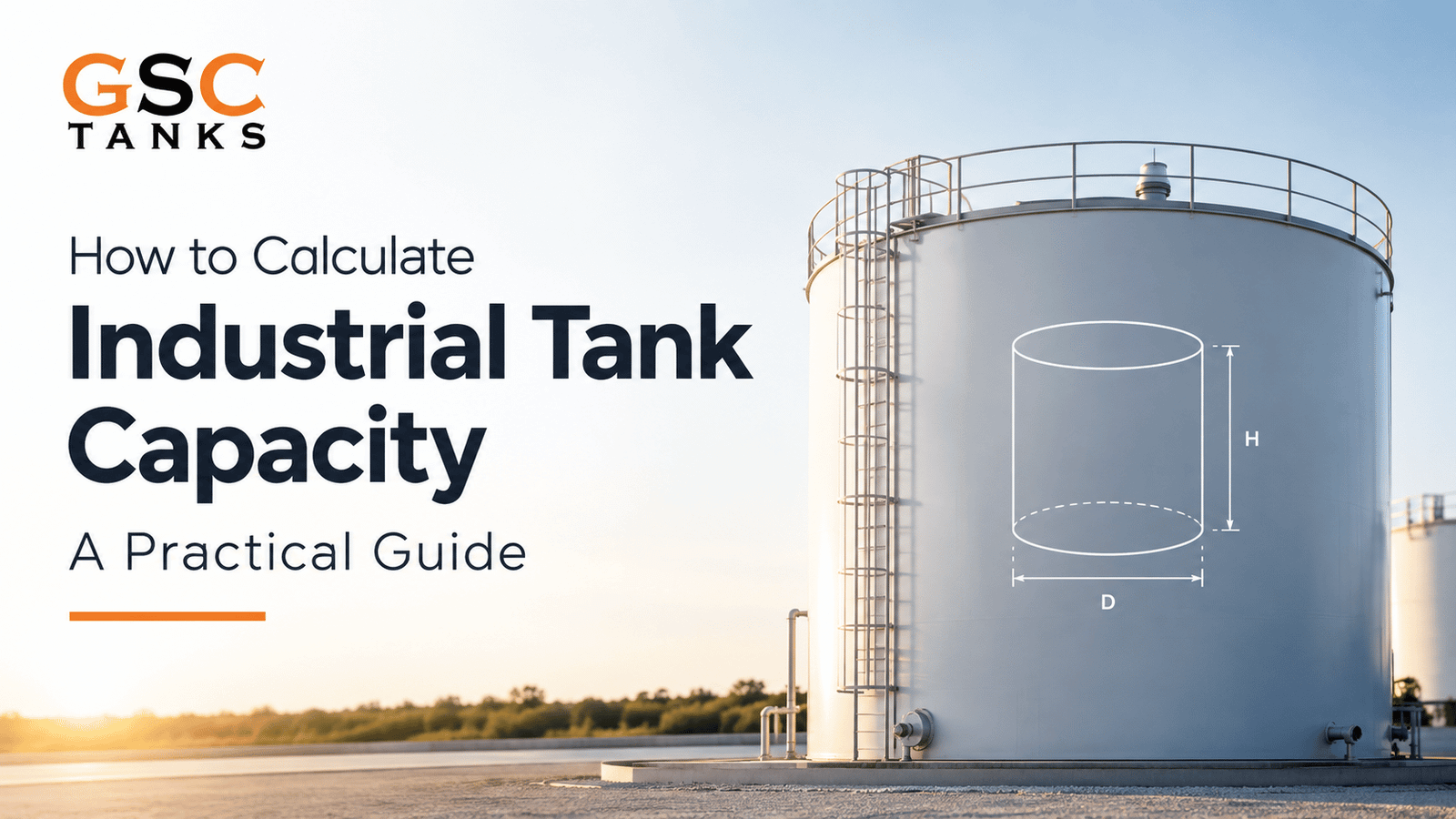
For a cylindrical tank, the standard volume formula is:
V = π × r² × h
Where:
- V = volume
- π = approximately 3.14159
- r = internal radius
- h = internal height or cylindrical length
If you know the tank diameter instead of the radius, use:
V = π × (D ÷ 2)² × h
Where D is the internal diameter.
This formula works well for estimating the geometric volume of a cylindrical tank. However, the actual design may require additional calculations when the tank has special heads, internal components, unusual geometry, or a partial fill condition.
How to Calculate the Capacity of a Vertical Cylindrical Tank
Vertical cylindrical tanks are common in industrial storage applications.
They are used for water, chemicals, process liquids, fuels, and many other materials.
For a vertical cylindrical tank, use:
V = π × r² × h
Example
Suppose a tank has:
- Diameter = 10 feet
- Height = 20 feet
First, calculate the radius:
Radius = 10 ÷ 2 = 5 feet
Now apply the formula:
V = 3.14159 × 5² × 20
V = 1,570.8 cubic feet
So, the approximate geometric volume is 1,570.8 cubic feet.
To convert cubic feet to US gallons:
1 cubic foot ≈ 7.48052 US gallons
Therefore:
1,570.8 × 7.48052 ≈ 11,745 gallons
The tank therefore has an approximate geometric capacity of 11,745 US gallons.
This is a geometric estimate. The usable operating volume may be lower.
How to Calculate Tank Capacity in Gallons
Many industrial projects in the United States use gallons for tank sizing.
If your dimensions are in feet, calculate the volume in cubic feet first.
Then use:
US gallons = cubic feet × 7.48052
For example:
1,000 cubic feet × 7.48052 = 7,480.52 gallons
You can also calculate capacity in cubic meters and then convert it to liters:
1 cubic meter = 1,000 liters
For accurate project documentation, always state the unit being used. This is particularly important when specifications involve both metric and US customary measurements.
How to Calculate a Horizontal Cylindrical Tank
Horizontal cylindrical tanks require more care.
If the tank is completely full, you can use the standard cylinder formula:
V = π × r² × L
Here, L represents the cylindrical length of the tank.
However, the calculation becomes more complex when the tank is only partially filled.
Why?
Because the liquid occupies only part of the circular cross-section.
The liquid height must therefore be considered. A partial-fill calculation uses the area of a circular segment and then multiplies that area by the tank length.
For this reason, operators should not simply multiply the tank’s full capacity by the percentage shown on a level gauge unless the tank’s geometry and calibration support that approach.
For critical applications, use the manufacturer’s capacity table, calibrated level system, or an appropriate engineering calculation.
How to Calculate the Capacity of a Rectangular Tank
Some industrial tanks have rectangular or square geometry.
The calculation is simpler:
V = L × W × H
Where:
- L = length
- W = width
- H = height
Example
Suppose a rectangular tank measures:
- Length = 10 feet
- Width = 8 feet
- Height = 6 feet
Then:
V = 10 × 8 × 6
V = 480 cubic feet
Convert this to US gallons:
480 × 7.48052 = approximately 3,590 gallons
Therefore, the geometric capacity is about 3,590 US gallons.
Again, the working capacity may be lower.
How to Calculate Cone-Bottom Tank Capacity
Cone-bottom tanks need additional consideration because their geometry changes from the cylindrical section to the cone.
The volume of a cone is:
V = ⅓ × π × r² × h
Where:
- r = radius
- h = cone height
If a tank has both a cylindrical body and a cone bottom, calculate each section separately.
Then add the volumes together.
Total volume = cylindrical volume + cone volume
However, the exact usable capacity depends on the tank design and the liquid level.
This is one reason tank manufacturers use detailed drawings and specifications when producing custom tanks.
GSC Tanks supplies industrial tanks in several configurations, including vertical, cone-bottom, and horizontal tanks.
Total Capacity vs. Working Capacity
This distinction is important when selecting an industrial storage tank.
Imagine a tank with a geometric capacity of 20,000 gallons.
That does not automatically mean the process should operate at 20,000 gallons.
The facility may need additional space above the normal liquid level.
This space can help accommodate:
- Thermal expansion
- Process fluctuations
- Filling variations
- Foam
- Surge volume
- Operational safety margins
- Regulatory requirements
Therefore, tank selection should start with the required working volume, not simply the maximum physical volume.
For example, if a process requires 15,000 gallons of usable storage, an engineer may select a tank with a larger gross capacity after considering the operating conditions.
The exact margin should be determined from the specific application and applicable engineering requirements.
What Factors Affect Industrial Tank Capacity?
Tank dimensions are only one part of the decision.
Several other factors can affect the required tank size.
1. Material Being Stored
The stored material matters.
Water, acids, solvents, fuels, wastewater, and process chemicals can have very different storage requirements.
The material can affect:
- Tank material
- Lining requirements
- Temperature control
- Density
- Corrosion resistance
- Operating limits
For chemical storage, tank selection should therefore consider compatibility in addition to volume.
GSC Tanks supplies industrial tanks made from materials such as polyethylene, fiberglass, steel, stainless steel, alloy, and reinforced concrete.
2. Required Storage Volume
Start with the actual process requirement.
Ask:
- How much material enters the facility?
- How much material leaves the tank?
- How often is the tank refilled?
- What is the required reserve?
- How much working volume is needed?
- Will demand increase in the future?
These questions help determine the required capacity.
3. Tank Dimensions
Capacity depends heavily on diameter and height.
For a cylinder, increasing the diameter has a significant effect because the radius is squared in the volume formula.
Therefore, a small increase in diameter can produce a large increase in volume.
4. Available Installation Space
A tank may have the required capacity but still be unsuitable for the site.
Consider:
- Available footprint
- Tank height
- Access roads
- Transportation limitations
- Foundation requirements
- Maintenance access
- Clearance around the tank
- Local site restrictions
For large-capacity projects, field erection can become an important consideration. GSC Tanks explains that field-erected tanks can be useful for projects where transportation limits make very large shop-built tanks impractical.
5. Liquid Density
Capacity and weight are not the same thing.
A tank may hold a certain number of gallons, but the stored liquid can weigh much more or less than water.
For example, a chemical with a specific gravity greater than 1 weighs more than the same volume of water.
Therefore, engineers must consider both volume and operating weight when designing the tank and its supporting system.
6. Temperature
Temperature can change liquid volume.
Some liquids expand significantly as temperature increases.
Therefore, the design should account for the expected operating and storage temperature range.
Temperature can also affect the tank material and the need for insulation or heating.
How Do You Choose the Right Industrial Tank Size?
Tank sizing should follow the actual process requirements.
A practical approach is to start with these questions:
Step 1: Determine the Required Working Volume
Calculate the amount of material that must be available during normal operation.
Step 2: Determine the Required Reserve
Consider demand fluctuations and supply interruptions.
Step 3: Determine the Stored Material
Identify the liquid and review its properties.
Step 4: Select a Suitable Tank Material
The material must be compatible with the stored product and operating conditions.
Step 5: Select the Tank Geometry
Choose between vertical, horizontal, cone-bottom, rectangular, or another suitable configuration.
Step 6: Check the Installation Site
Confirm that the tank can be transported, installed, supported, inspected, and maintained safely.
Step 7: Confirm Applicable Standards
The tank may need to meet specific engineering standards, codes, or local requirements.
Step 8: Review the Final Design
A qualified tank manufacturer or engineer should confirm the final dimensions and design requirements.
Why Tank Shape Matters
Two tanks can have the same capacity but very different dimensions.
For example, one tank may be tall and narrow. Another may be shorter and wider.
Both can hold the same volume.
However, they may not have the same installation requirements.
Tank shape can affect:
- Foundation design
- Available site area
- Access
- Transportation
- Mixing
- Cleaning
- Structural requirements
- Cost
Therefore, capacity alone should not determine the final tank configuration.
How Capacity Affects Tank Selection
GSC Tanks offers multiple industrial tank types and materials. Its product range includes field-erected tanks, steel and alloy tanks, fiberglass tanks, and polyethylene tanks.
The best option depends on more than capacity.
For example, a chemical storage project may require a material with suitable chemical resistance. A very large water-storage project may have different structural and installation needs.
Likewise, a facility with limited transportation access may benefit from a field-erected solution.
That is why tank sizing should be treated as part of the overall engineering process.
Common Mistakes When Calculating Tank Capacity
Capacity calculations can look simple. However, small mistakes can create major problems.
Using Outside Dimensions
Use the appropriate internal dimensions when calculating the internal geometric volume.
Tank wall thickness affects the internal volume.
Confusing Diameter and Radius
The radius is half the diameter.
If the diameter is 10 feet, the radius is 5 feet.
Using 10 feet as the radius would produce a significantly incorrect result.
Ignoring Units
Do not mix inches, feet, meters, gallons, and liters in the same calculation without converting them.
Keep the units consistent.
Treating Gross Capacity as Working Capacity
A tank’s physical volume is not always its recommended operating volume.
Always consider the required operating level.
Ignoring Tank Geometry
A standard cylinder formula may not accurately represent a tank with special heads, cone sections, internal components, or partial filling.
Choosing Capacity Without Considering the Material
A tank is not selected based on volume alone.
Material compatibility, density, temperature, corrosion resistance, and operating conditions all matter.
Does Secondary Containment Affect Tank Sizing?
Yes, it can affect the overall installation.
Secondary containment is separate from the tank’s internal storage capacity. However, the containment system must be sized according to the applicable regulatory requirements.
For example, EPA guidance for facilities subject to the federal SPCC requirements states that bulk storage secondary containment must provide capacity for the largest single tank or container plus sufficient freeboard for precipitation. EPA also provides calculation worksheets for certain containment configurations.
Therefore, do not assume that one universal percentage applies to every tank and every regulatory program.
The correct requirement depends on the facility, stored material, regulatory program, and containment design.
When Should You Use a Tank Capacity Calculator?
A tank capacity calculator can be useful during the early planning stage.
It can help you:
- Estimate tank volume
- Compare tank dimensions
- Convert units
- Check preliminary specifications
- Estimate storage requirements
However, a calculator should not replace detailed engineering review.
For a simple cylindrical tank, the calculation is straightforward.
For complex tanks, the final capacity may require manufacturer drawings, calibrated volume tables, or engineering software.
Example: Selecting a Tank for an Industrial Process
Suppose a facility needs approximately 15,000 gallons of working storage.
The facility receives material several times per week. It also needs additional volume for normal operating fluctuations.
The process team should not simply order a 15,000-gallon tank.
Instead, the team should determine:
- Required working volume.
- Required reserve volume.
- Material density.
- Material compatibility.
- Operating temperature.
- Tank location.
- Foundation requirements.
- Required tank configuration.
- Applicable standards.
- Required secondary containment.
After reviewing these factors, the required gross tank capacity can be established.
This approach produces a better result than selecting a tank based on volume alone.
Why Professional Tank Sizing Matters
Industrial storage tanks can be large and complex.
A small calculation error can affect:
- Storage availability
- Structural loading
- Installation
- Process efficiency
- Material compatibility
- Safety
- Project cost
For that reason, preliminary calculations should be checked against the actual tank design.
GSC Tanks provides engineered storage tank solutions for industrial and agricultural facilities as well as municipal water and wastewater applications. Its tanks are available in several materials and configurations to suit different storage requirements.
If you already know your required capacity, dimensions, material, and application, those details can help a tank manufacturer determine the appropriate solution.
Frequently Asked Questions About Industrial Tank Capacity
How do you calculate industrial tank capacity?
For a basic cylindrical tank, use V = π × r² × h. Use internal dimensions and keep the units consistent. Then convert the result into gallons, liters, cubic feet, or cubic meters as needed.
What is the formula for a cylindrical tank?
The basic formula is:
V = π × r² × h
If the diameter is known, use:
V = π × (D ÷ 2)² × h
How do you calculate tank capacity in gallons?
First calculate the volume in cubic feet. Then multiply by approximately 7.48052 to convert cubic feet to US gallons.
Is tank capacity the same as working capacity?
No. Total or gross capacity refers to the tank’s physical volume. Working capacity refers to the volume intended for normal operation. Working capacity may be lower because of operating limits, freeboard, expansion, or other requirements.
How do you calculate the capacity of a horizontal tank?
A completely full horizontal cylindrical tank can use the standard cylinder formula. However, a partially filled horizontal tank requires a calculation based on the liquid level and circular segment geometry. Manufacturer capacity tables or calibrated level systems can provide more practical results.
How do you calculate a rectangular tank?
Multiply length by width by height:
V = L × W × H
The result is the volume in cubic units based on the units used for the dimensions.
What information does a tank manufacturer need for sizing?
Useful information includes the required capacity, stored material, specific gravity, operating temperature, tank location, dimensions or space limitations, operating conditions, and applicable standards or regulatory requirements.
Can the same tank capacity be used for different chemicals?
Not necessarily. Different chemicals can require different tank materials, linings, design conditions, and operating limits. Capacity is only one part of tank selection.
Conclusion
Calculating industrial storage tank capacity is an important first step in tank selection.
For simple cylindrical tanks, the basic formula is easy to use. However, real industrial projects involve more than geometry.
The required tank size can depend on working volume, stored material, temperature, density, site limitations, tank configuration, standards, and operating conditions.
Therefore, use capacity calculations as a starting point. Then confirm the final tank design with an experienced manufacturer or qualified engineer.
GSC Tanks provides engineered industrial storage tanks in steel, stainless steel, alloy, fiberglass, polyethylene, and reinforced concrete. The company also supports different tank configurations and industrial applications.
For a custom tank project, the right capacity is not simply the largest number that fits the site. It is the capacity that matches the process, material, operating conditions, and long-term requirements.
Category
- Above Ground Fuel Tanks
- Above Ground Gas Storage Tank
- Above Ground Storage Tanks
- Above Ground Water Storage Tanks
- Agricultural Tanks
- Chemical storage Tanks
- Diesel Fuel Storage Tanks
- Diesel Storage Tanks
- Exernal FloatingRoof Tanks
- Farm Water Tank
- Fiberglass Oil Tanks
- Fiberglass Septic Tanks
- Fiberglass Tanks
- Fiberglass Underground Fuel Storage Tanks
- Field Erected Tanks
- Floating Roof Tank
- Food and Beverage Tanks
- Fuel tank
- Industrial Chemical Storage Tanks
- Industrial Gas Tanks
- Industrial Hot Water Storage Tanks
- industrial hot water tank
- Industrial Plastic Tanks
- Industrial Storage Tanks
- Industrial Tank heating pads
- industrial tanks
- Natural gas
- Natural gas vs Propane
- oil storage tank
- Oil Storage Tanks
- Peracitic Acid
- Petroleum Tanks
- Residential gasoline storage tanks
- Residential Water Storage Tanks
- Sodium Hydroxide Storage Requirements
- Sodium Hypochlorite Storage Tanks
- Steel Storage Tanks
- storage tank failure prevention
- Storage Tanks
- Sulfuric Acid Tanks
- Uncategorized
- UnderGround Storage Tanks
- Waste water tank
- Water Storage Tanks