

- GSC Tanks
- October 6, 2026
How to Calculate Industrial Storage Tank Turnover: A Guide to Inventory, Demand & Tank Sizing
Industrial storage tank turnover helps plant managers, engineers, and procurement teams understand how quickly stored material moves through a tank. It also helps them connect tank capacity with actual demand. Therefore, turnover can support better inventory planning, delivery scheduling, and tank sizing.
However, tank turnover is more than a simple capacity calculation. A tank may have a large nameplate capacity, yet its usable working volume may be much smaller. Likewise, average demand may hide short periods of peak consumption.
For that reason, a proper storage plan should consider working volume, demand, replenishment time, safety stock, and operating limits.
This guide explains how to calculate tank turnover and use the result when planning industrial storage capacity.
What Is Industrial Storage Tank Turnover?
Industrial storage tank turnover measures how often the stored volume moves through a tank during a specific period.
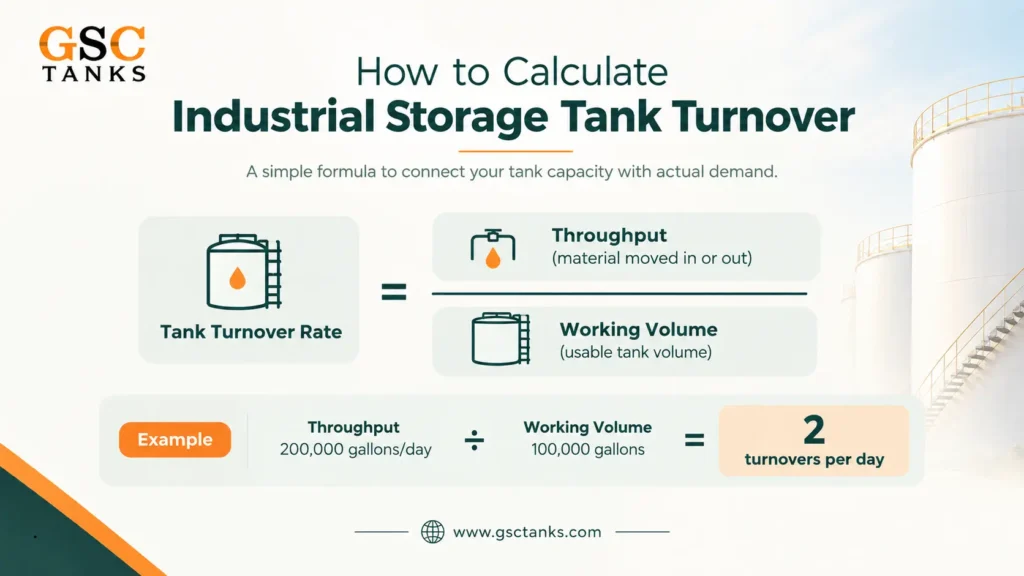
For example, suppose a tank has a working volume of 100,000 gallons. If the facility uses 200,000 gallons over one day, the tank experiences a nominal turnover of 2 times per day.
The basic formula is:
Tank Turnover Rate = Throughput ÷ Working Volume
You can also calculate turnover for a year:
Annual Turnover = Annual Throughput ÷ Working Volume
The U.S. Environmental Protection Agency uses a similar concept for calculating tank turnovers per year by dividing throughput by working volume.
However, turnover should not be treated as a universal performance target. The appropriate rate depends on the product, process, demand pattern, tank configuration, and operating requirements.
Tank Turnover Rate vs. Turnover Time
These terms sound similar, but they answer different questions.
Turnover rate
Turnover rate tells you how many tank volumes move through the tank during a period.
Formula:
Turnover Rate = Throughput ÷ Working Volume
For example:
- Working volume = 100,000 gallons
- Daily throughput = 200,000 gallons
Therefore:
200,000 ÷ 100,000 = 2 turnovers per day
Turnover time
Turnover time tells you how long it would take to move an amount equal to the working volume at a given average throughput.
Formula:
Turnover Time = Working Volume ÷ Throughput
Using the same example:
100,000 ÷ 200,000 = 0.5 day
That equals approximately 12 hours.
In other words, the tank has a nominal turnover time of 12 hours at that average throughput.
Why Working Volume Matters
One of the most common mistakes in tank planning is using the tank’s total physical capacity as the available storage.
That approach can produce an unrealistic result.
A tank may require:
- Headspace or ullage
- A minimum operating level
- A heel or residual volume
- Emergency reserve
- Process-specific operating limits
- Space for expansion or thermal effects
Therefore, working volume is normally more useful for turnover calculations than the tank’s total geometric volume.
GSC Tanks’ existing industrial storage tank capacity guide explains the difference between total capacity and working capacity and shows why tank dimensions alone do not determine usable storage.
How to Calculate Industrial Storage Tank Turnover
Follow these steps.
Step 1: Determine the Working Volume
Start with the volume that the facility can actually use during normal operation.
For example:
Tank nameplate capacity: 250,000 gallons
Usable working volume: 210,000 gallons
Use 210,000 gallons for the turnover calculation.
Do not automatically use 250,000 gallons simply because that is the tank’s rated or geometric capacity.
Step 2: Determine Actual Throughput
Next, calculate how much material enters or leaves the tank during the selected period.
Use actual operating data when possible.
For example:
Daily throughput: 70,000 gallons/day
If demand changes significantly during the year, calculate both:
- Average demand
- Peak demand
The average figure helps with inventory planning. Peak demand helps with capacity planning.
Step 3: Calculate the Turnover Rate
Now apply the formula:
Turnover Rate = Throughput ÷ Working Volume
Using the example:
70,000 ÷ 210,000 = 0.33 turnovers/day
So the tank turns over approximately one-third of its working volume each day.
Step 4: Calculate Turnover Time
You can also calculate the inverse:
Turnover Time = Working Volume ÷ Daily Throughput
Therefore:
210,000 ÷ 70,000 = 3 days
The nominal turnover time is approximately 3 days.
This gives the facility a simple way to understand how long one working-volume equivalent takes to move through the tank.
How to Use Demand When Sizing a Tank
Turnover alone does not tell you the correct tank size.
You also need to understand how much material the facility consumes and how often it receives replenishment.
Consider a facility that uses:
20,000 gallons per day
The supplier delivers material every:
7 days
The basic storage requirement becomes:
20,000 × 7 = 140,000 gallons
So the facility needs at least 140,000 gallons of working storage to cover that demand interval.
However, real operations rarely follow a perfect schedule.
Deliveries can arrive late. Demand can increase. Production can change. Therefore, the facility may need additional reserve capacity.
Add a Safety Stock Factor
Suppose the facility wants a 15% planning reserve.
The calculation becomes:
Required Working Volume = Daily Demand × Days of Coverage × Safety Factor
Using the example:
20,000 × 7 × 1.15 = 161,000 gallons
The facility would therefore need approximately 161,000 gallons of working storage.
This is a planning calculation, not a final engineering specification.
The actual reserve should reflect the material, supply chain, process requirements, delivery reliability, and facility risk profile.
Working Capacity Is Not the Same as Gross Capacity
Now consider a tank that needs 161,000 gallons of working storage.
Suppose the preliminary design allows:
- 10% ullage
- 5% unavailable bottom volume
That leaves approximately 85% of gross capacity available for the planned working volume.
The simplified calculation becomes:
Gross Capacity = Working Volume ÷ 0.85
Therefore:
161,000 ÷ 0.85 = 189,412 gallons
A project team might then evaluate the next suitable standard or custom tank size, such as approximately 200,000 gallons.
However, the final tank specification should account for the actual tank geometry, operating levels, material properties, structural requirements, applicable standards, and project conditions.
How Peak Demand Changes Tank Sizing
Average demand can be useful, but it may not represent the real operating requirement.
Consider this example:
Average demand: 20,000 gallons/day
Peak demand: 30,000 gallons/day
If you size the tank only around average demand, the facility may struggle during peak production.
For that reason, ask:
- What is the highest expected daily demand?
- How long can peak demand continue?
- How quickly can the tank be replenished?
- What happens if a delivery arrives late?
- Does the process require continuous supply?
- Is a minimum reserve required?
The answers can significantly change the required working volume.
A Simple Industrial Tank Sizing Example
Let’s put everything together.
Assume a manufacturing facility has:
- Average consumption: 20,000 gallons/day
- Peak consumption: 30,000 gallons/day
- Maximum delivery interval: 7 days
- Planning reserve: 15%
- Ullage and unavailable volume allowance: 15%
Step 1: Calculate peak storage demand
30,000 × 7 = 210,000 gallons
Step 2: Add the planning reserve
210,000 × 1.15 = 241,500 gallons
So the preliminary working-storage requirement is:
241,500 gallons
Assuming 85% of gross capacity is available for the planned working volume:
241,500 ÷ 0.85 = 284,118 gallons
The project team would then evaluate a suitable tank size around this requirement.
The final selection should not rely on this calculation alone. Tank geometry, operating limits, structural design, material compatibility, installation conditions, applicable codes, and the characteristics of the stored product must also be reviewed.
What Happens If the Tank Is Too Small?
An undersized tank can create several operational problems.
For example, it may require:
- More frequent deliveries
- More frequent filling cycles
- Greater dependence on supply schedules
- Additional transportation costs
- More production risk during delivery delays
- Reduced operating flexibility
Furthermore, a tank that cannot maintain enough reserve may force a facility to react to demand instead of planning for it.
That can become especially important when the stored material supports a continuous manufacturing process.
What Happens If the Tank Is Too Large?
Bigger is not automatically better.
An oversized tank can:
- Increase capital expenditure
- Require more installation space
- Increase structural and foundation requirements
- Hold material longer than necessary
- Reduce inventory efficiency
- Create additional maintenance requirements
Therefore, the goal should not be to install the largest possible tank.
The goal is to select a tank with appropriate working capacity for the actual operating requirement.
Consider Delivery Frequency
Supplier delivery schedules can have a major effect on tank sizing.
Suppose two facilities each consume 20,000 gallons per day.
Facility A receives deliveries every 3 days.
Facility B receives deliveries every 10 days.
Their demand is identical. Their storage requirements are not.
Facility A has a basic demand coverage requirement of:
20,000 × 3 = 60,000 gallons
Facility B needs:
20,000 × 10 = 200,000 gallons
Therefore, supply logistics can influence tank capacity almost as much as production demand.
This is why tank sizing should involve both operations and procurement teams.
Account for Seasonal Demand
Demand may also change throughout the year.
For example, an agricultural operation may have higher storage requirements during a busy production period.
Similarly, industrial facilities may experience:
- Seasonal production
- Planned shutdowns
- Maintenance periods
- Contract-driven demand
- Temporary production increases
- Changes in raw-material supply
Therefore, use historical operating data whenever possible.
A single average number may hide important capacity requirements.
Tank Turnover and Residence Time Are Not Always the Same in Practice
A simple turnover calculation assumes that the tank behaves in an ideal way.
Real tanks can behave differently.
Flow patterns, inlet and outlet locations, tank geometry, stratification, dead zones, and operating levels can affect how material actually moves through the vessel.
Therefore, a calculated turnover rate should be treated as a planning metric, not proof that every part of the tank experiences identical turnover.
This distinction becomes especially important for applications where product age, mixing, temperature, concentration, or water quality matters.
For example, the U.S. EPA has documented how tank turnover and liquid-level changes factor into storage-tank calculations and notes that constant-level or surge tanks can require a different approach.
A Practical Tank Turnover Checklist
Before selecting an industrial storage tank, review these questions:
Demand
- What is the average daily consumption?
- What is the peak daily consumption?
- Does demand change seasonally?
Inventory
- How many days of inventory are required?
- What minimum reserve should the facility maintain?
- How much material can remain in the tank without affecting operations?
Supply
- How often can deliveries arrive?
- What is the maximum delivery delay?
- Can the supplier increase delivery frequency during peak demand?
Tank capacity
- What is the total tank volume?
- What is the working volume?
- How much ullage is required?
- Is there a minimum operating level?
Operations
- Does the material require mixing?
- Does residence time matter?
- Does temperature affect the stored material?
- Can the tank operate at the required fill range?
Design
- Which tank material is appropriate?
- Is the tank above ground or below grade?
- What applicable standards and specifications apply?
- What site limitations affect tank dimensions?
GSC Tanks supplies multiple tank types, including field-erected tanks, steel and alloy tanks, fiberglass tanks, and polyethylene tanks. The appropriate solution depends on the application and project requirements.
Use a Tank Size Calculator as a Starting Point
Once you understand demand and working volume, a calculator can make the initial sizing process easier.
GSC Tanks provides a Tank Size Calculator that allows users to work with tank dimensions and capacity.
However, a calculator should support the engineering process rather than replace it.
A final tank specification should consider the stored product, operating conditions, tank configuration, material compatibility, structural requirements, applicable standards, installation conditions, and other project-specific factors.
When Should You Recalculate Tank Capacity?
Revisit your storage calculation whenever the operating conditions change.
For example, recalculate the requirement if:
- Production increases
- Product demand changes
- Delivery frequency changes
- A new supplier changes delivery lead times
- The facility adds another production line
- Seasonal demand increases
- The tank operating range changes
- The stored product changes
- The facility adds or removes storage tanks
This simple review can prevent a storage system from becoming a production constraint.
Frequently Asked Questions
What is the formula for industrial tank turnover?
The basic formula is:
Tank Turnover Rate = Throughput ÷ Working Volume
For annual turnover, divide annual throughput by the tank’s working volume.
How do you calculate tank turnover time?
Use:
Turnover Time = Working Volume ÷ Throughput
For example, a 100,000-gallon working volume with 25,000 gallons of daily throughput has a nominal turnover time of 4 days.
Should I use total tank capacity or working volume?
Use working volume for a basic turnover calculation. Total tank capacity includes volume that may not be available during normal operation.
How do you calculate the storage capacity needed for demand?
Start with:
Required Working Volume = Demand × Required Days of Coverage
Then consider safety stock, delivery reliability, peak demand, operating limits, and other project-specific requirements.
Does higher tank turnover always mean better performance?
No. There is no universal turnover rate that works for every industrial application.
The appropriate turnover depends on the stored material, process, demand pattern, tank design, and operating requirements.
Can an oversized tank create problems?
Yes. An oversized tank can increase capital and installation costs and may hold material longer than necessary. Therefore, tank sizing should balance capacity, demand, reserve requirements, and operational needs.
Does tank material affect sizing?
Tank material may affect the design, configuration, operating conditions, and suitability of the tank. The selection should consider the stored material, chemical compatibility, temperature, mechanical requirements, installation conditions, and applicable specifications.
Final Takeaway
Industrial storage tank sizing should start with real operating demand, not simply the largest available tank.
First, determine the working volume. Next, calculate average and peak demand. Then, review delivery intervals and required inventory coverage. After that, add an appropriate reserve and account for unavailable tank volume.
Finally, evaluate the resulting capacity against the actual tank design and application.
The basic relationship is simple:
Turnover Rate = Throughput ÷ Working Volume
But good tank planning requires more than one formula.
When demand, inventory, supply schedules, working volume, and operating conditions all work together, a facility can choose storage capacity with greater confidence and avoid both insufficient storage and unnecessary oversizing.
For application-specific tank selection, GSC Tanks provides engineered industrial storage solutions across multiple tank materials and configurations. Contact GSC Tanks to discuss the storage requirements for your project.
External technical reference: The U.S. EPA TANKS User’s Guide explains the calculation of tank turnovers using throughput and working volume and provides additional context for specialized tank situations.
- Calculate Industrial Storage Tank Turnover
Category
- Above Ground Fuel Tanks
- Above Ground Gas Storage Tank
- Above Ground Storage Tanks
- Above Ground Water Storage Tanks
- Agricultural Tanks
- Chemical storage Tanks
- Diesel Fuel Storage Tanks
- Diesel Storage Tanks
- Exernal FloatingRoof Tanks
- Farm Water Tank
- Fiberglass Oil Tanks
- Fiberglass Septic Tanks
- Fiberglass Tanks
- Fiberglass Underground Fuel Storage Tanks
- Field Erected Tanks
- Floating Roof Tank
- Food and Beverage Tanks
- Fuel tank
- Industrial Chemical Storage Tanks
- Industrial Gas Tanks
- Industrial Hot Water Storage Tanks
- industrial hot water tank
- Industrial Plastic Tanks
- Industrial Storage Tanks
- Industrial Tank heating pads
- industrial tanks
- Natural gas
- Natural gas vs Propane
- oil storage tank
- Oil Storage Tanks
- Peracitic Acid
- Petroleum Tanks
- Residential gasoline storage tanks
- Residential Water Storage Tanks
- Sodium Hydroxide Storage Requirements
- Sodium Hypochlorite Storage Tanks
- Steel Storage Tanks
- storage tank failure prevention
- Storage Tanks
- Sulfuric Acid Tanks
- Uncategorized
- UnderGround Storage Tanks
- Waste water tank
- Water Storage Tanks