

- GSC Tanks
- August 9, 2026
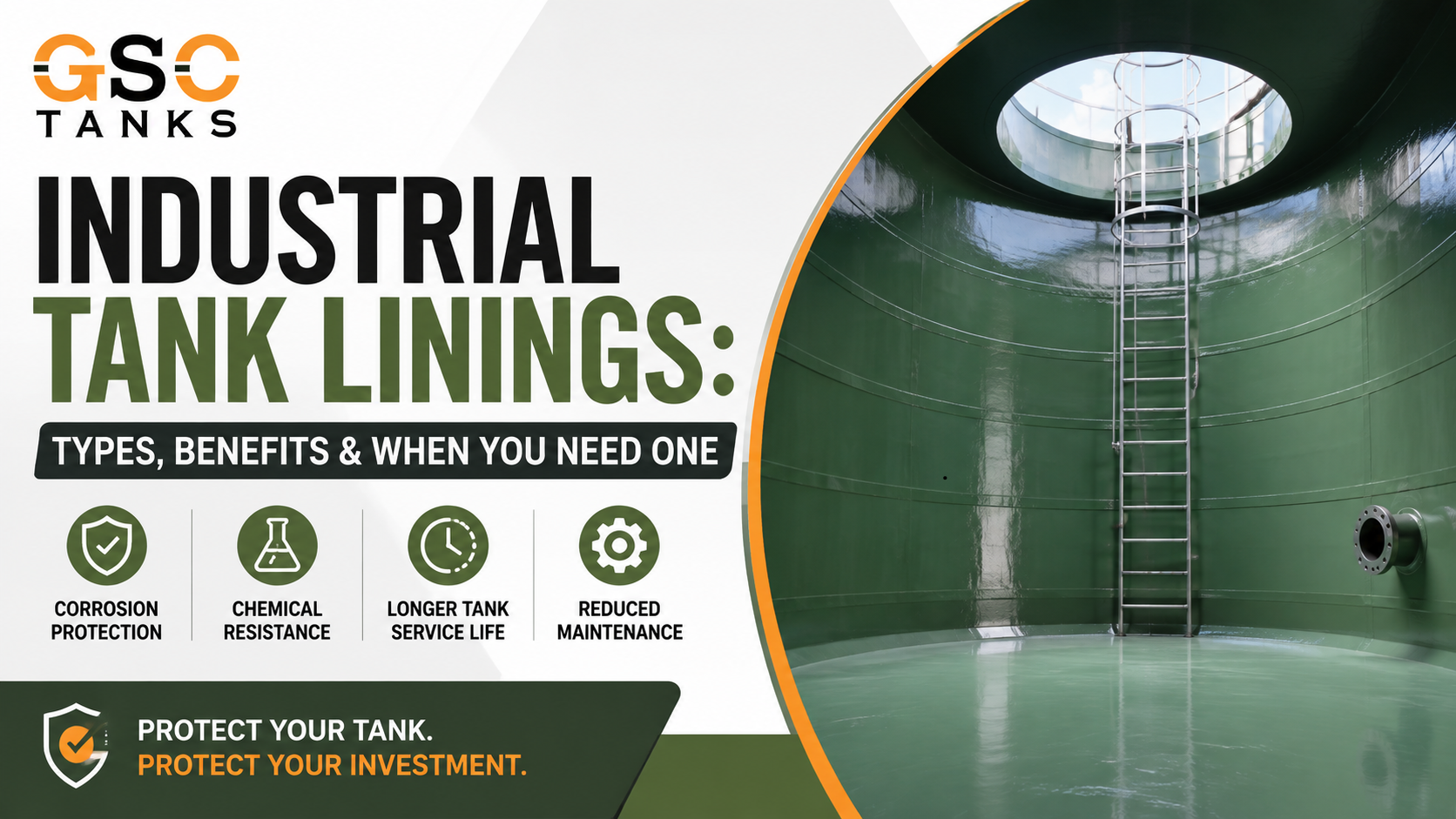
Industrial Tank Linings: Types, Benefits & When You Need One
Industrial storage tanks often hold chemicals, wastewater, process liquids, fuels, and other materials. Some of these materials can damage the tank surface over time.
That is where an industrial tank lining can help.
A tank lining creates a protective barrier between the stored material and the tank surface. It can help reduce corrosion and chemical damage. It can also extend the useful life of the tank.
However, not every tank needs the same lining.
The right choice depends on several factors. These include the stored material, chemical concentration, temperature, tank material, and operating conditions.
In this guide, we explain the main types of industrial tank linings. We also explain their benefits and when you may need one.
What Is an Industrial Tank Lining?
An industrial tank lining is a protective layer applied to the inside of a storage tank.
The lining separates the stored product from the tank surface.
For example, a carbon steel tank may provide excellent structural strength. However, some chemicals can corrode exposed steel.
A compatible lining can create a barrier between the chemical and the steel.
Common tank lining materials include:
- Epoxy
- Vinyl ester
- Rubber
- Polyurethane
- Glass-flake systems
- Thermoplastics
- Specialty lining systems
The lining does not replace proper tank design. Instead, it adds another layer of protection.
Why Do Industrial Tanks Need Linings?
Tank linings can serve several important purposes.
1. Corrosion Protection
Corrosion can damage industrial storage tanks over time.
Some chemicals react with metal surfaces. This can cause rust, pitting, and wall loss.
A suitable lining can reduce direct contact between the stored product and the tank surface.
For example, API Recommended Practice 652 addresses internal tank bottom linings for aboveground petroleum storage tanks. It covers areas such as lining selection, surface preparation, application, curing, and inspection.
2. Chemical Resistance
Some liquids are highly corrosive.
Examples include certain:
- Acids
- Alkalis
- Solvents
- Salts
- Wastewater streams
- Process chemicals
A suitable lining can help protect the tank from these materials.
However, no single lining works for every chemical.
Therefore, chemical compatibility must come first.
3. Product Protection
The stored product can also benefit from a lining.
A lining reduces direct contact between the product and the tank substrate.
This can help reduce the risk of contamination in suitable applications.
4. Longer Tank Service Life
Corrosion can shorten tank service life.
A suitable lining can help protect the tank surface. As a result, it may reduce internal deterioration.
However, a lining does not guarantee a specific service life.
Performance depends on the lining material, application quality, chemical exposure, temperature, and maintenance.
5. Reduced Maintenance
Preventing damage is usually easier than repairing severe corrosion.
Therefore, a lining can form part of a broader tank maintenance strategy.
It should work alongside proper inspection and maintenance.
Types of Industrial Tank Linings
Different applications require different lining systems.
Therefore, you should select a lining based on the actual service conditions.
Epoxy Tank Linings
Epoxy linings are common in industrial applications.
They can provide good adhesion and chemical resistance.
They are used in applications involving:
- Water
- Wastewater
- Chemicals
- Industrial liquids
However, not every epoxy system has the same performance.
The formulation matters.
Therefore, always check chemical and temperature compatibility before selecting an epoxy lining.
Vinyl Ester Linings
Vinyl ester systems can provide strong chemical resistance.
They are often considered for demanding chemical applications.
They can be useful when the stored material is highly aggressive.
However, the exact formulation matters.
The resin, reinforcement, thickness, and application process can all affect performance.
Rubber Linings
Rubber linings can provide chemical and abrasion resistance.
They can also offer flexibility.
These properties can make rubber useful in selected industrial applications.
However, the rubber type must match the service conditions.
Consider the chemical, temperature, abrasion, and mechanical conditions before selection.
Polyurethane Linings
Polyurethane systems can provide a combination of flexibility and abrasion resistance.
Some formulations also provide good chemical resistance.
They can work well in applications where mechanical wear is a concern.
However, performance varies between formulations.
Therefore, do not select a polyurethane lining based only on its material name.
Glass-Flake Linings
Glass-flake systems contain small glass flakes within a resin.
These flakes can create a longer path for corrosive substances to travel through the lining.
As a result, properly designed systems can provide strong barrier protection.
They are often considered for demanding chemical applications.
Thermoplastic Linings
Thermoplastic materials can provide strong resistance to certain chemicals.
They can be used as liners or as part of a lining system.
However, compatibility remains critical.
A thermoplastic material that works well with one chemical may not work well with another.
How Do You Choose the Right Tank Lining?
Choosing a tank lining should start with the application.
Do not simply choose the thickest or most expensive option.
Instead, consider the conditions inside the tank.
1. Identify the Stored Material
First, identify exactly what the tank will store.
Do not use a broad description such as “chemical.”
Identify the actual chemical or product.
Also, provide its composition when necessary.
2. Check Chemical Concentration
Chemical concentration matters.
A chemical can behave differently at different concentrations.
Therefore, provide the expected concentration range when selecting a lining.
3. Consider Temperature
Temperature can affect lining performance.
High temperatures can increase chemical activity.
They can also affect the physical properties of some lining systems.
Therefore, consider:
- Normal operating temperature
- Maximum temperature
- Minimum temperature
- Temperature changes
4. Consider Immersion Conditions
Will the tank stay full most of the time?
Will it be filled and emptied often?
Will the lining experience continuous immersion?
These factors can affect lining selection.
5. Consider Abrasion
Some tanks contain solids or suspended particles.
These materials can cause abrasion.
Mixers, pumps, and cleaning systems can also create mechanical wear.
Therefore, consider abrasion resistance when necessary.
6. Identify the Tank Material
The tank substrate matters.
For example, a lining applied to carbon steel may require a different preparation process than one applied to concrete.
The substrate should be inspected before selecting the lining system.
7. Consider Cleaning Requirements
Some tanks require regular cleaning.
Others may use aggressive cleaning chemicals.
Therefore, the lining should withstand the expected cleaning process.
This factor is especially important in applications where cleaning occurs frequently.
Tank Lining vs. Tank Coating: What’s the Difference?
People often use the terms tank lining and tank coating interchangeably.
However, they can describe different applications.
A coating generally provides a protective layer on a surface.
A lining often provides a thicker or more substantial barrier. It is commonly used for immersion or demanding chemical service.
The exact terminology can vary by industry.
For example, AMPP discusses heavy-duty lining systems for severe exposure conditions in wastewater facilities.
Therefore, do not select a system based only on its name.
Instead, look at its actual performance requirements.
When Does an Industrial Storage Tank Need a Lining?
Not every industrial tank needs an internal lining.
A lining may be useful when:
- The stored product is corrosive.
- The tank material has limited chemical resistance.
- The tank requires extra corrosion protection.
- The tank will experience continuous immersion.
- Product contamination is a concern.
- The operating environment is aggressive.
- Existing corrosion needs to be controlled.
- The tank specification requires a protective barrier.
On the other hand, some tank materials may already provide sufficient resistance.
That is why tank material selection and lining selection should work together.
If you are still choosing the right tank material, read GSC Tanks’ guide on how to choose the right industrial storage tank.
How Is an Industrial Tank Lining Installed?
A good lining requires more than applying material to the tank.
Proper preparation is critical.
A typical lining project can include these steps.
Step 1: Inspect the Tank
First, inspect the tank.
Look for:
- Corrosion
- Pitting
- Cracks
- Weld problems
- Surface contamination
- Existing coatings
- Areas that need repair
Step 2: Prepare the Surface
Surface preparation is one of the most important steps.
The lining needs a clean and suitable surface.
Depending on the project, preparation may include:
- Abrasive blasting
- Mechanical preparation
- Cleaning
- Removal of old coatings
- Surface profiling
AMPP maintains standards for surface preparation before coating and lining work. These standards address factors such as surface cleanliness and surface profile.
Step 3: Repair Surface Defects
The lining cannot fix every structural problem.
Therefore, repair serious defects before applying the lining.
This can help prevent future problems.
Step 4: Apply the Lining
Next, apply the selected lining system.
Follow the manufacturer’s requirements.
Application conditions can affect the final result.
Important factors include:
- Temperature
- Humidity
- Surface condition
- Mixing
- Application thickness
- Recoat time
Step 5: Allow Proper Curing
The lining needs enough time to cure.
The required curing time depends on the product and application conditions.
Do not return the tank to service before the lining has properly cured.
Step 6: Inspect the Finished Lining
The finished lining should be inspected.
Depending on the project, inspection may include:
- Visual inspection
- Thickness measurement
- Adhesion testing
- Holiday testing
- Other specified tests
AMPP maintains standards for discontinuity testing of protective coatings on conductive surfaces.
What Causes Tank Lining Failure?
A lining can fail when the system does not match the application.
Common causes include:
- Incorrect chemical compatibility
- Poor surface preparation
- Excessive moisture
- Incorrect thickness
- Poor mixing
- Inadequate curing
- Excessive temperature
- Heavy abrasion
- Mechanical damage
- Contamination
Therefore, selecting a good lining product is only one part of the process.
Proper preparation matters too.
So does application, inspection, and maintenance.
Can an Existing Storage Tank Be Lined?
In many cases, an existing tank can be evaluated for lining.
However, inspect the tank first.
An existing tank may have:
- Corrosion
- Pitting
- Cracks
- Old coatings
- Contamination
- Weld problems
- Structural deterioration
A lining should not hide a structural problem.
Instead, inspect the tank and determine whether repairs are needed.
The tank should also be checked for suitability before lining work begins.
For more information about tank construction materials, read GSC Tanks’ article on the strength of steel and reinforced concrete tanks.
Industries That Use Tank Linings
Tank linings can support many industrial applications.
Chemical Processing
Chemical plants often handle corrosive materials.
A suitable lining can help protect storage tanks from chemical exposure.
Water and Wastewater
Water and wastewater tanks can face several forms of corrosion.
These may include chemical and biological exposure.
Therefore, the lining should match the actual service conditions.
Mining
Mining operations may store:
- Process water
- Slurries
- Reagents
- Chemicals
These applications can create both chemical and abrasion challenges.
Power Generation
Power plants use tanks for many purposes.
These can include:
- Water treatment
- Fuels
- Process liquids
- Treatment chemicals
Each application requires its own material assessment.
Food and Beverage
Food and beverage applications require careful material selection.
Cleaning and sanitation requirements also matter.
The lining should therefore suit both the stored product and the cleaning process.
Pulp and Paper
Pulp and paper facilities use several chemicals and process liquids.
Some of these materials can create aggressive corrosion conditions.
A suitable lining can help protect the tank surface.
How Long Does an Industrial Tank Lining Last?
There is no single answer.
Lining life depends on the application.
Important factors include:
- Lining material
- Chemical exposure
- Chemical concentration
- Temperature
- Immersion conditions
- Abrasion
- Surface preparation
- Application quality
- Curing
- Inspection
- Maintenance
For example, a lining used for water storage may face very different conditions from one used for aggressive chemicals.
Therefore, do not rely on a generic lifespan.
Instead, select the lining based on the actual service environment.
Frequently Asked Questions
What is an industrial tank lining?
An industrial tank lining is a protective layer applied to the inside of a storage tank. It can help protect the tank substrate from corrosion, chemicals, abrasion, and other forms of damage.
What is the best lining for a chemical storage tank?
There is no universal best lining. The correct choice depends on the chemical, concentration, temperature, tank material, immersion conditions, and other operating requirements.
Are tank linings only used in steel tanks?
No. Lining systems can be used with different tank substrates. The correct system depends on the tank material and service conditions.
Can a corroded storage tank be lined?
Sometimes. However, inspect the tank first. Significant structural damage may require repair before lining work begins.
What is the difference between a tank lining and a coating?
A coating generally provides a protective surface layer. A lining often provides a more substantial barrier for immersion or aggressive service. However, terminology can vary between industries.
Does every chemical storage tank need a lining?
No. Some tank materials already provide suitable chemical resistance. Other applications may need additional protection.
How do you select an industrial tank lining?
Start with the stored material. Then consider its concentration, temperature, immersion conditions, abrasion, tank substrate, and cleaning requirements. Finally, select a lining system that suits those conditions.
Final Takeaway
An industrial tank lining can provide an important layer of protection.
It can help control corrosion. It can also improve resistance to chemical exposure.
However, the right lining depends on the application.
Before selecting a lining, consider:
- What the tank stores
- Chemical concentration
- Operating temperature
- Immersion conditions
- Abrasion
- Tank material
- Cleaning requirements
- Expected service conditions
Most importantly, do not choose a lining based only on price or thickness.
Choose a system that fits the actual operating environment.
Proper surface preparation also matters. So do correct application, curing, inspection, and maintenance.
When these factors work together, a suitable lining can help protect the tank and support reliable long-term operation.
If you need help evaluating an industrial storage tank, GSC Tanks can help you consider the tank material, design, and protection requirements for your application.
- Industrial Tank Linings
Category
- Above Ground Fuel Tanks
- Above Ground Gas Storage Tank
- Above Ground Storage Tanks
- Above Ground Water Storage Tanks
- Agricultural Tanks
- Chemical storage Tanks
- Diesel Fuel Storage Tanks
- Diesel Storage Tanks
- Exernal FloatingRoof Tanks
- Farm Water Tank
- Fiberglass Oil Tanks
- Fiberglass Septic Tanks
- Fiberglass Tanks
- Fiberglass Underground Fuel Storage Tanks
- Field Erected Tanks
- Floating Roof Tank
- Food and Beverage Tanks
- Fuel tank
- Industrial Chemical Storage Tanks
- Industrial Gas Tanks
- Industrial Hot Water Storage Tanks
- industrial hot water tank
- Industrial Plastic Tanks
- Industrial Storage Tanks
- Industrial Tank heating pads
- industrial tanks
- Natural gas
- Natural gas vs Propane
- oil storage tank
- Oil Storage Tanks
- Peracitic Acid
- Petroleum Tanks
- Residential gasoline storage tanks
- Residential Water Storage Tanks
- Sodium Hydroxide Storage Requirements
- Sodium Hypochlorite Storage Tanks
- Steel Storage Tanks
- storage tank failure prevention
- Storage Tanks
- Sulfuric Acid Tanks
- Uncategorized
- UnderGround Storage Tanks
- Waste water tank
- Water Storage Tanks